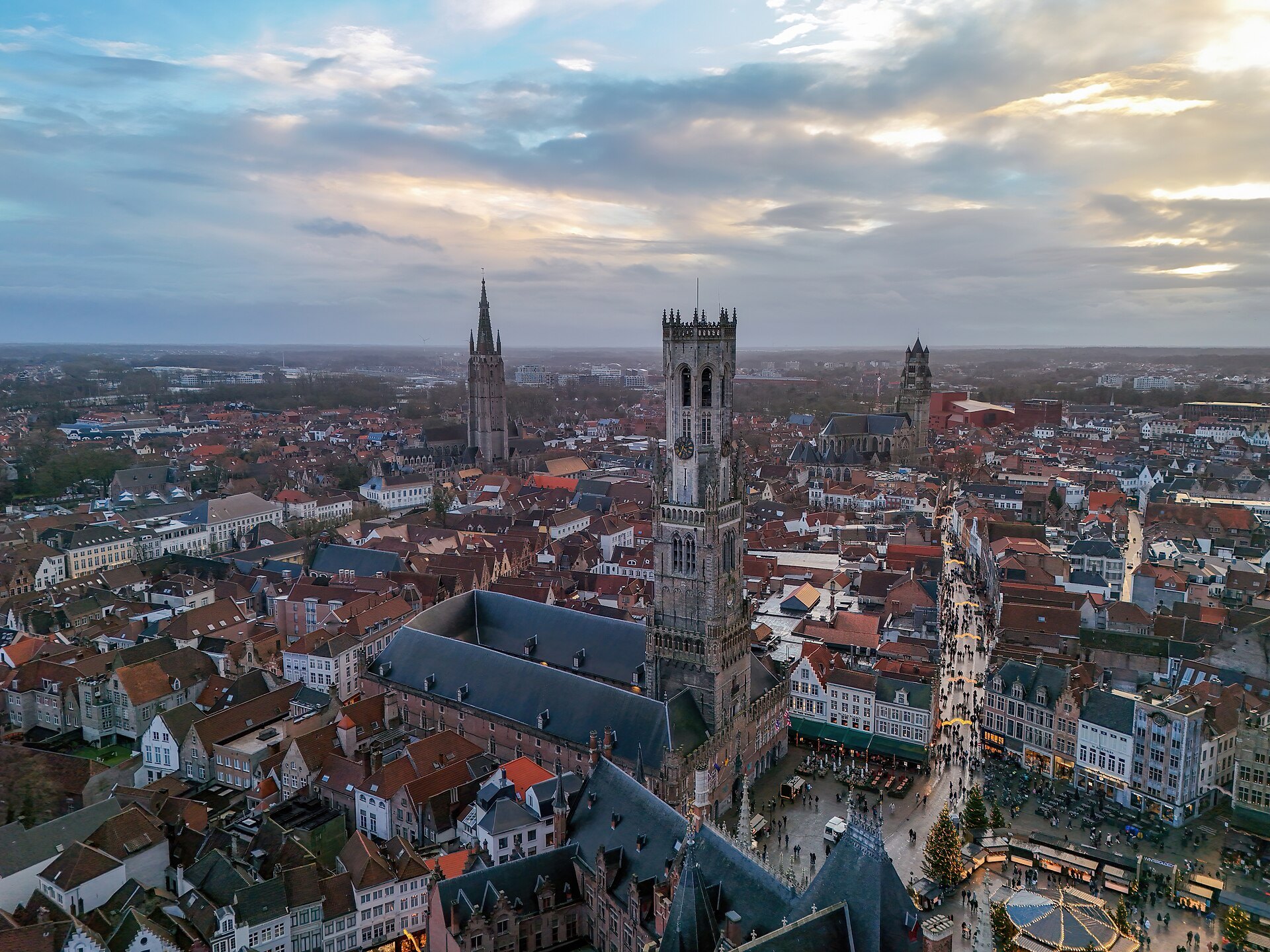
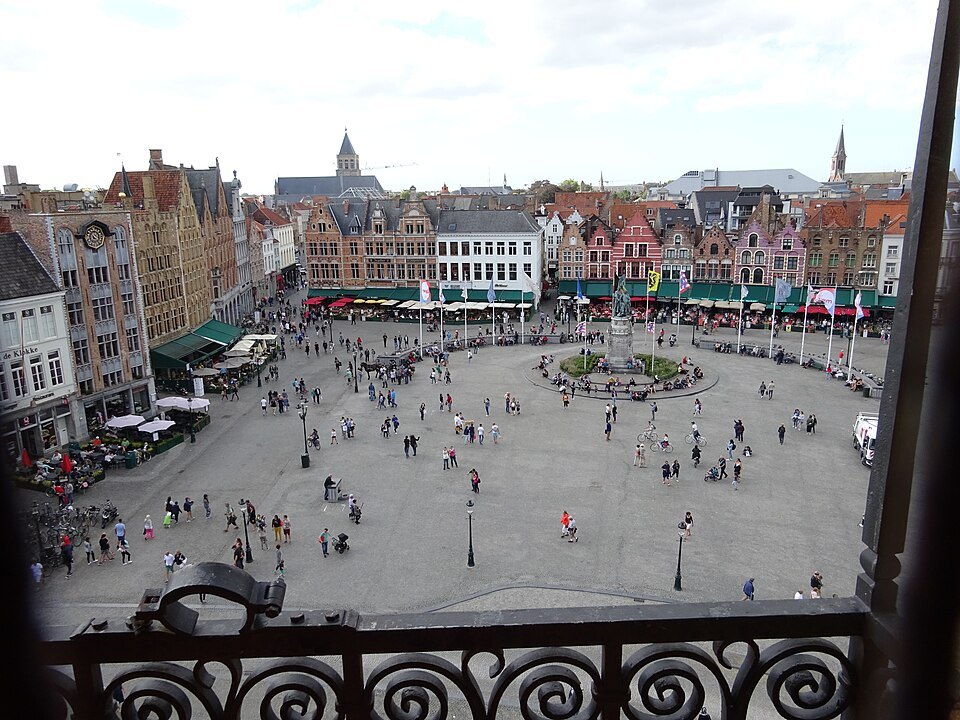
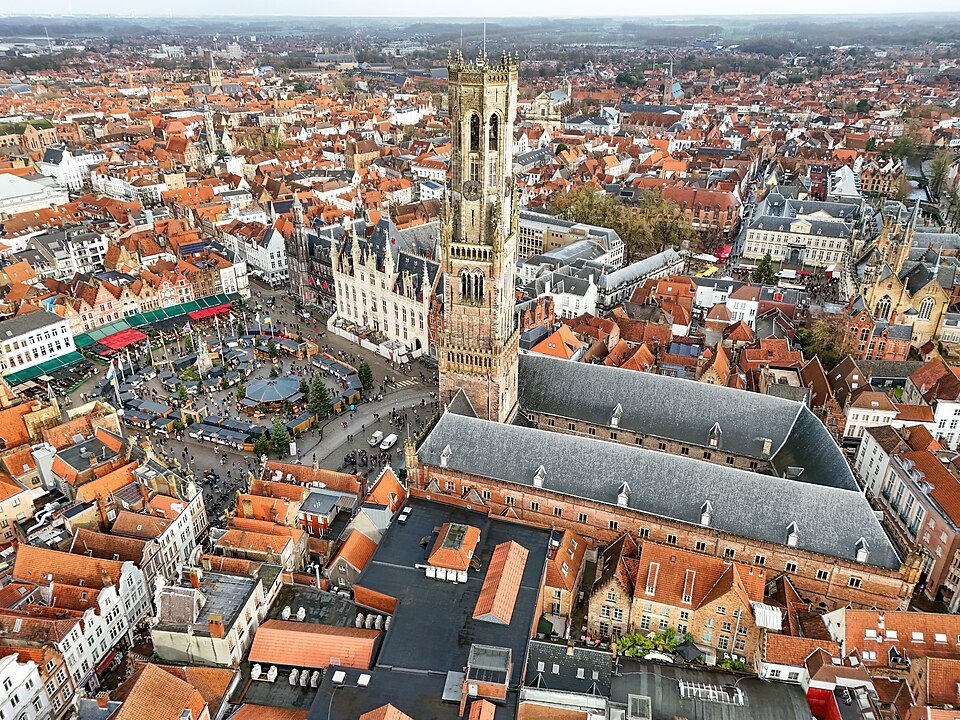
The brick and stone tower that has watched over the Markt since the thirteenth century, with a carillon of 47 bells and 366 steps to the top.
From the foot to the top
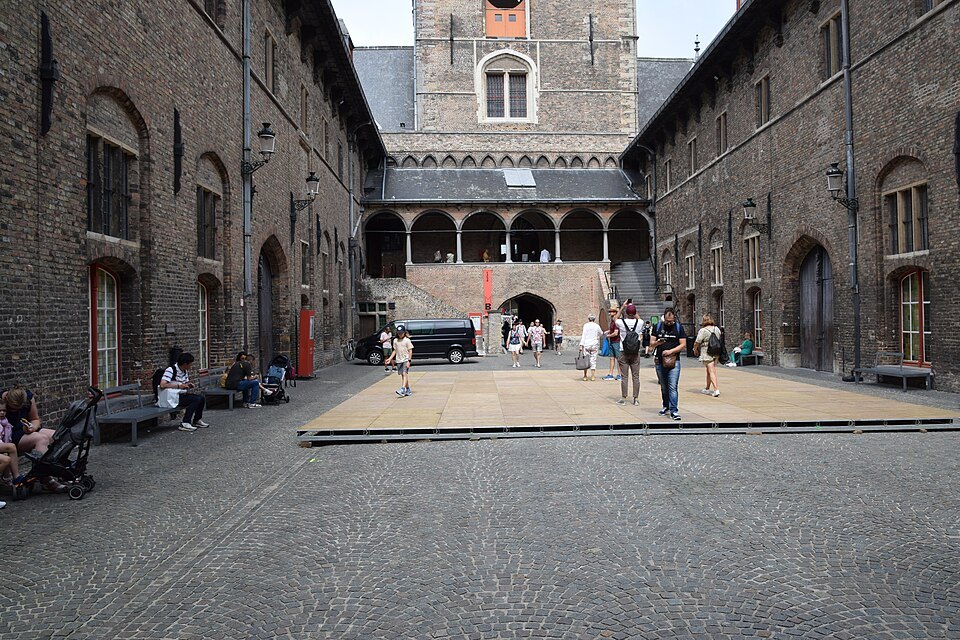
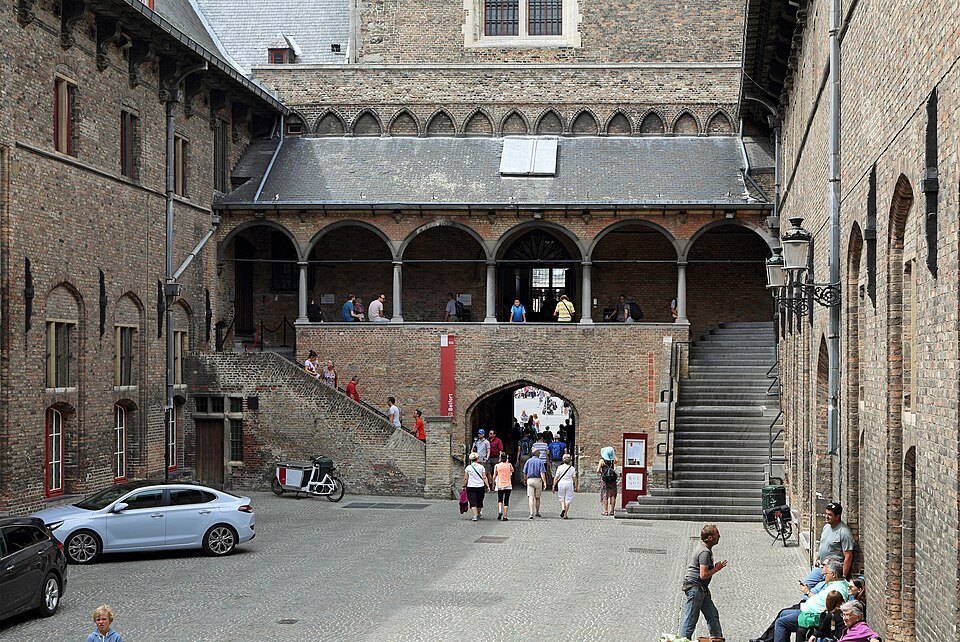
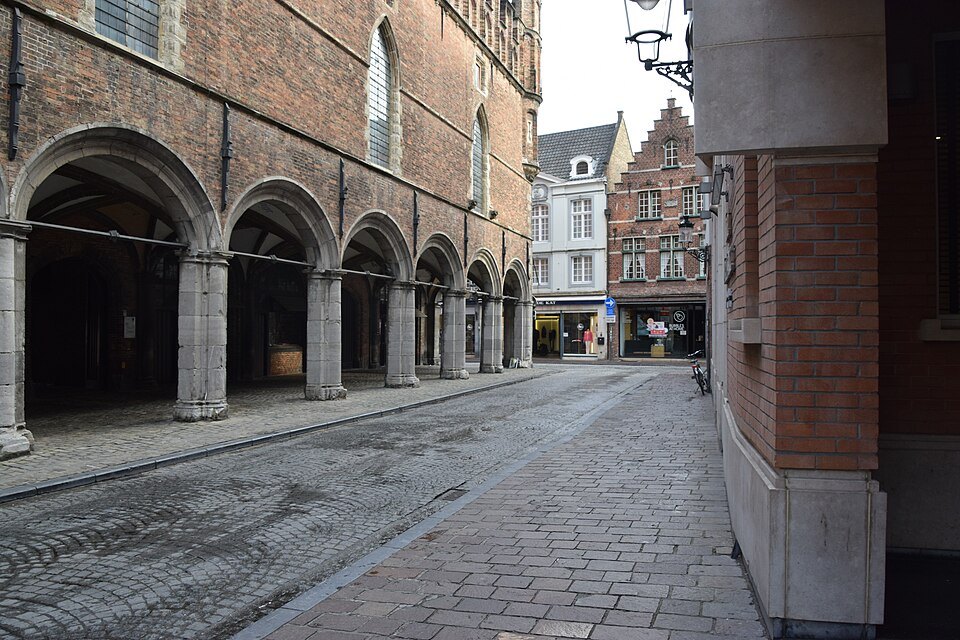
- FootThe market hallsThe low courtyard building at the tower's foot, where merchants once traded under one roof
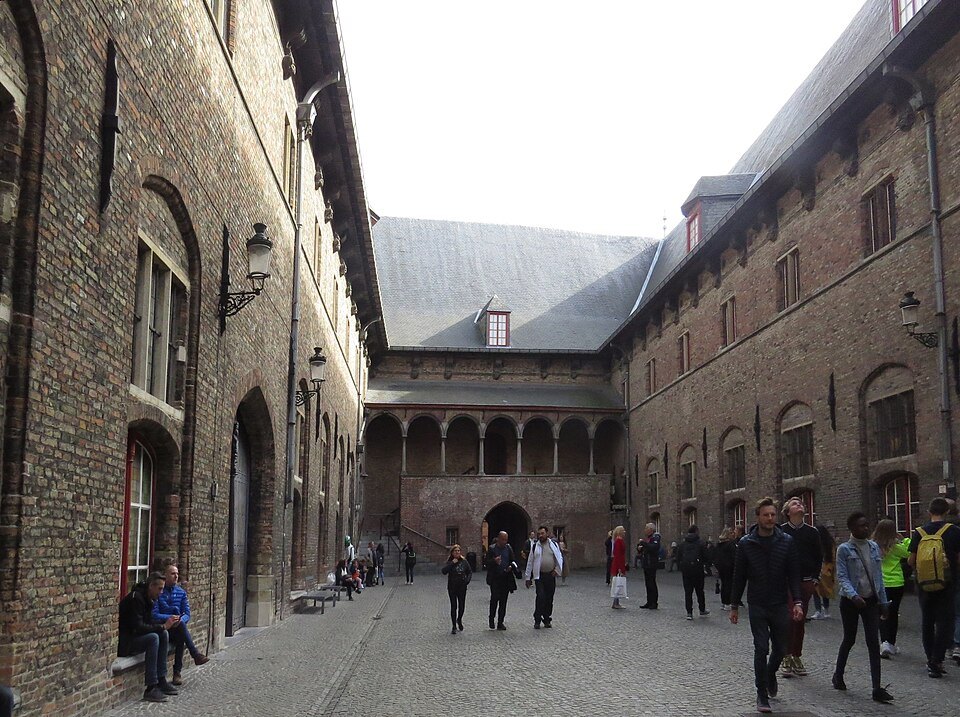
- The inner courtyardAn open court behind the arch, the quietest place on the Markt
- The treasuryThe room where the city once kept its charters, seals and money
- The carillon drumA great studded cylinder that plays the bells automatically, turning in plain view
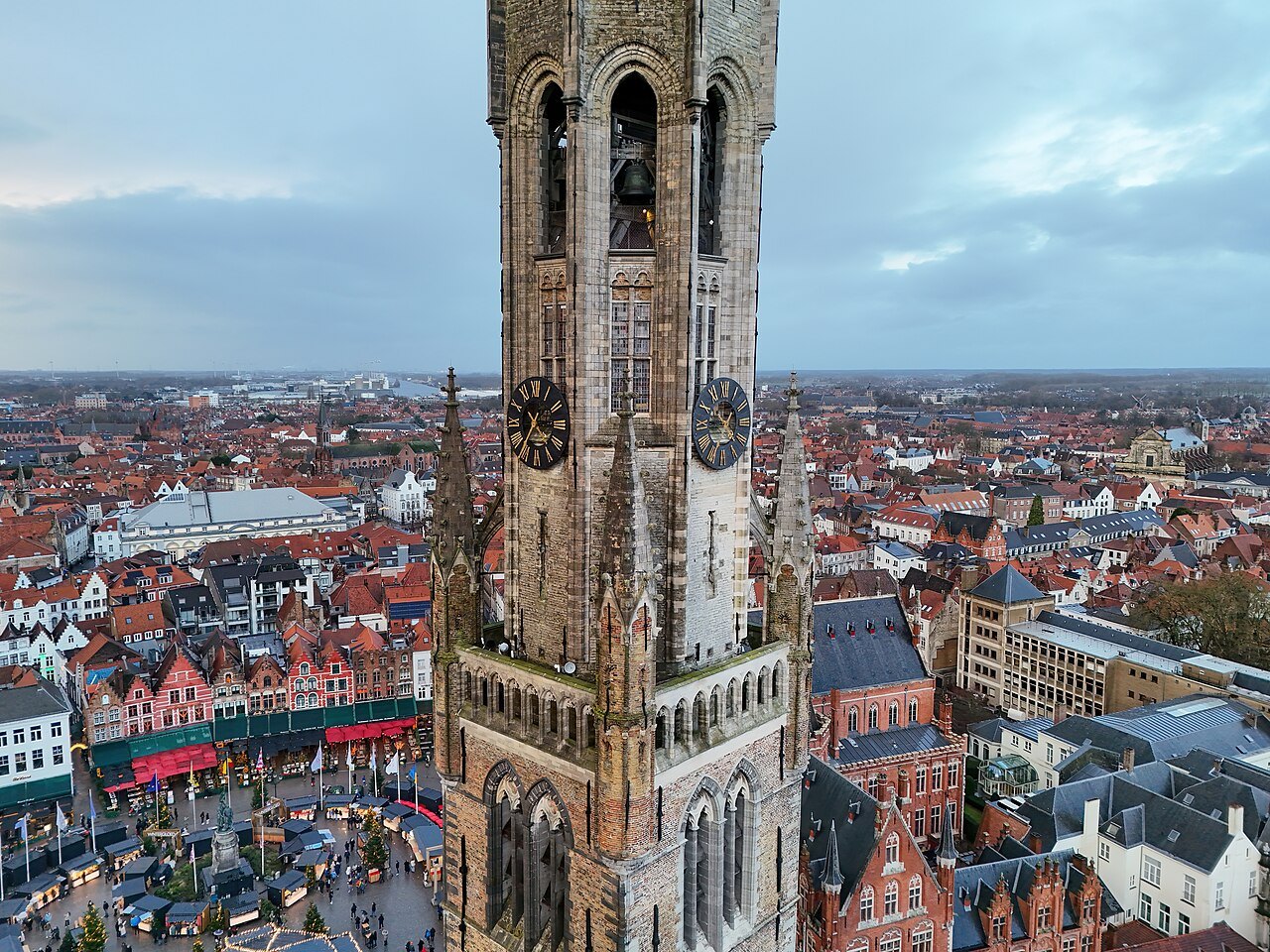
- The bell chamberThe 47 bells of the carillon hanging in the octagonal top stage
- TopThe view from the topRoofs, spires and canals in every direction, with the flat polder country beyond
Why it matters
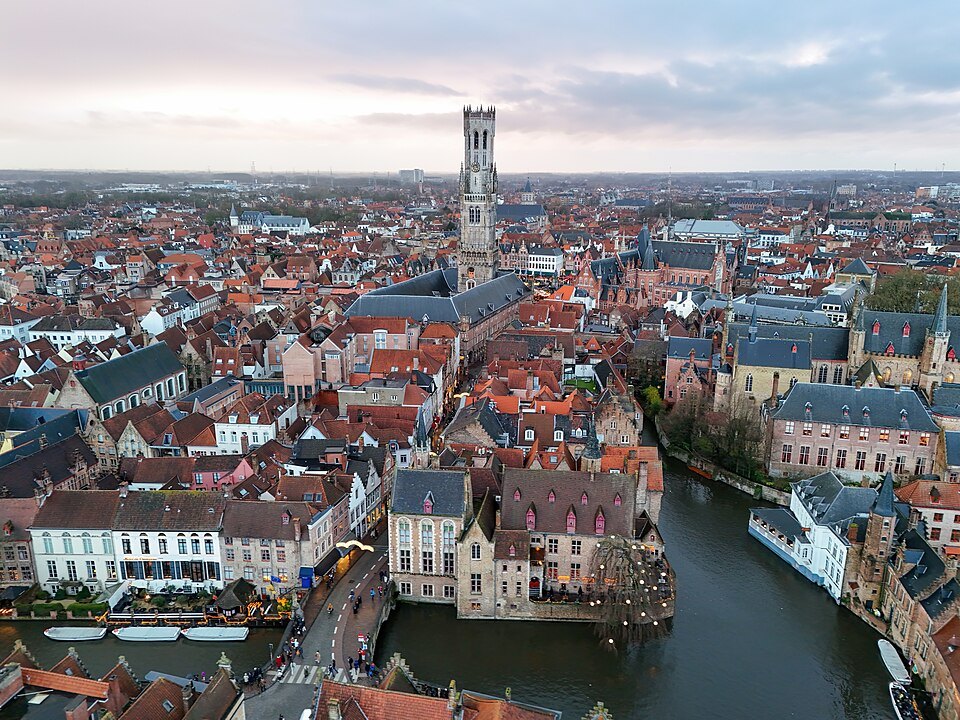
Every photograph of Bruges seems to have the Belfry in it somewhere. It rises from the south side of the Markt, 83 meters of tower above the old market halls, and it can be seen from almost every quay and bridge in the old town. For the medieval city it was more than a landmark: it was a watchtower, a treasury and the voice that rang out the hours, fires and calls to arms.
The tower belongs to two UNESCO listings at once. It was added in 1999 as one of the Belfries of Belgium and France, and it stands inside the historic center of Bruges, listed in 2000. Climbing it is the most physical thing most visitors do in the city, and the reward is the best view of how the town fits inside its ring of canals.
A tower rebuilt by fire
The first belfry was added to the Markt around 1240, together with the market halls at its foot. It did not stand long in its first form: a fire in 1280 destroyed the upper half of the tower and, with it, the city archives that had been kept inside. The lower part you see today goes back to the rebuilding that followed.
The distinctive octagonal top stage was added between 1483 and 1487. Six years later, in 1493, lightning struck and destroyed the spire and the bells. A wooden spire replaced it and burned in turn in 1741; after that, the tower was left without one, and a stone parapet was added in 1822. Before 1741 the Belfry stood about 102 meters tall.
Look at the tower from a distance and you may notice that it is not quite vertical. It leans 87 centimeters to the east, the result of centuries of weight on the soft ground beneath the Markt.
The bells
The carillon is the heart of the tower. A first set of 35 bells was cast in 1675 by Melchior de Haze. After the fire of 1741 they were replaced by bells from Joris Dumery, and 26 of his bells are still in use. Today the carillon has 47 bells with a combined weight of about twenty-seven and a half tonnes.
Most of the time the bells are played automatically by a huge drum set with pins, which turns and trips hammers against the bells as it rotates. The city carillonneur also plays live concerts from a keyboard in the tower on certain days each week; Musea Brugge lists them. When you visit, free hearing protection is handed out, in adult and child sizes, because the bells are loud at close range.
What you actually see
The visit starts in the courtyard of the market halls, an arcaded space that most people on the Markt never notice. From there the stairs begin, and they are the whole experience: 366 of them, getting narrower and steeper as you rise, with a few rooms along the way where you can stop.
On the way up you pass the treasury, where the medieval city kept its stamps, seals and funds. Higher up, the carillon room holds the playing drum and the keyboard, and you can watch the pins and levers move when the bells sound, before the stairs reach the bells themselves and the open view.
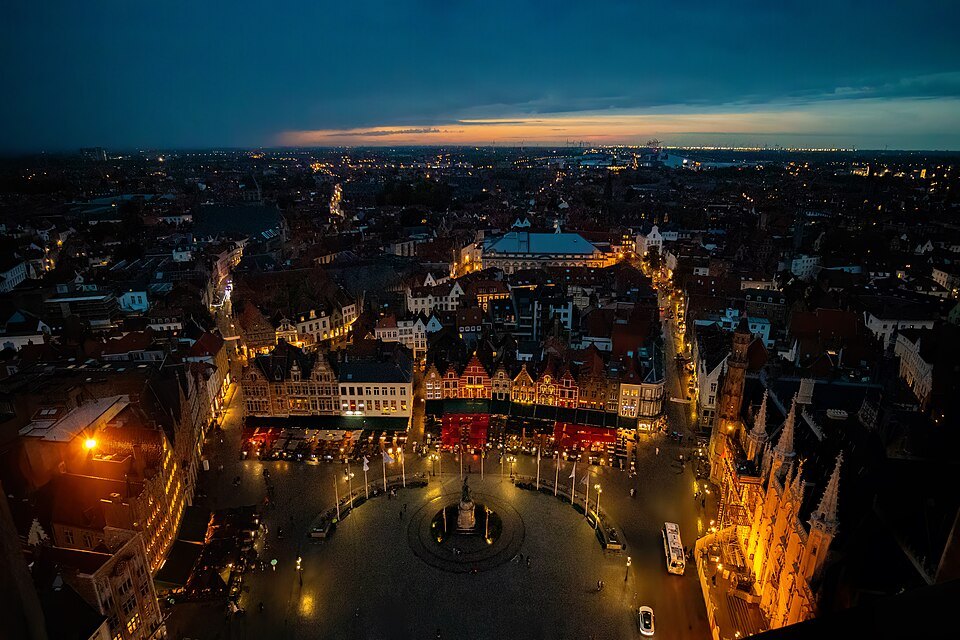
At the top, the view takes in the whole oval of the old town: the Burg and its spires close by, the tall brick tower of the Church of Our Lady to the south, and the flat land running away towards the coast. On a clear day it is easy to see why the medieval city wanted a watchman up here.
How to visit
The Belfry is one of the busiest sights in Bruges, and Musea Brugge strongly recommends booking a time slot online before you come. Tickets are for a set entry time and expire if you arrive late, so leave yourself a margin if you are coming from elsewhere in town.
Allow about an hour for the climb, the rooms on the way up and time at the top. There is no lift and the entrance itself is reached by stairs, so the tower is not accessible for wheelchair users, and the steep, narrow steps are not suitable for visitors with visual impairments. A tactile model of the tower is available for visitors who cannot climb.
If you can, time your slot so that you are near the bells just before an hour strikes: the drum and hammers are at their most impressive then. Musea Brugge describes the tower as a good family visit, but small children will need a hand on the steep upper flights.
Combining it with the rest of the center
The Belfry is the natural first stop of a walk through Bruges. The Markt spreads out in front of it, the Burg is a two-minute walk away along Breidelstraat, and the famous view of the tower from the water is from the Rozenhoedkaai, five minutes further south.
Seeing the tower from below matters as much as climbing it. Come back in the evening, when the Markt is quieter and the tower is lit, or walk the quays south of the Burg and look back for the moments when it appears between the roofs. For what to fit around it, see the itineraries.
Nearby
- The two squaresThe MarktThe great open square at the center of Bruges, framed by gabled guild-style houses, the neo-Gothic Provincial Court and…Read the page
- The two squaresThe BurgThe square where Bruges began as a fortress of the counts of Flanders, now ringed by the Gothic City Hall, the Holy…Read the page
- Along the DijverRozenhoedkaaiThe bend of quay where the canal turns under brick houses and the Belfry rises behind them, once the salt quay of…Read the page