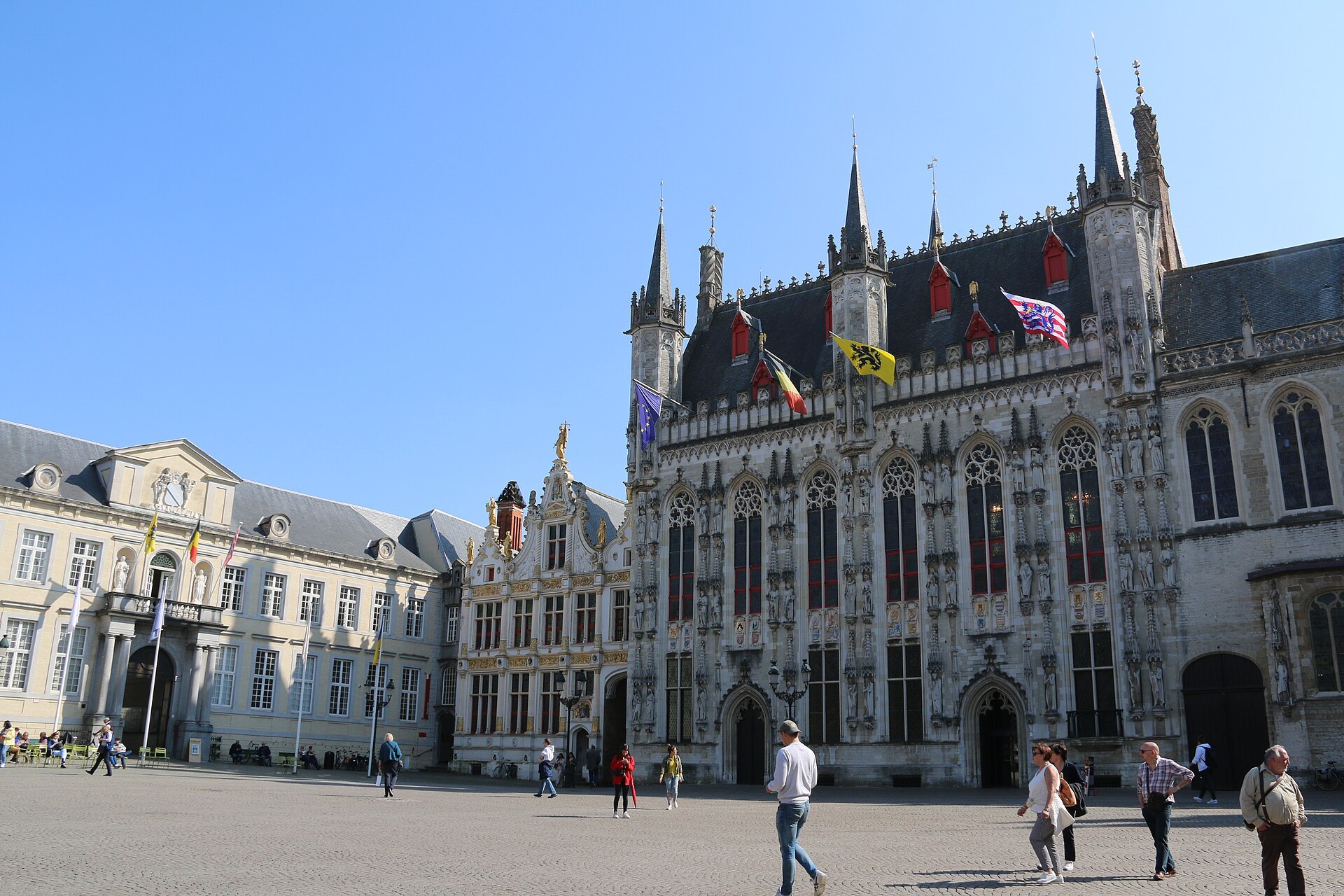
The square where Bruges began as a fortress of the counts of Flanders, now ringed by the Gothic City Hall, the Holy Blood chapel and six centuries of civic buildings.
Around the square
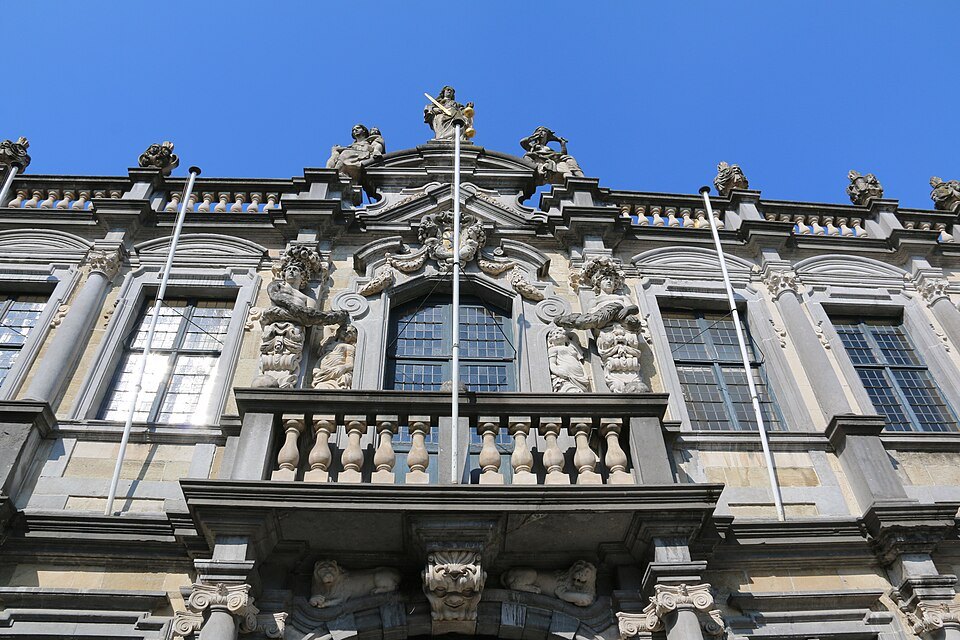
- 1The City HallLate Gothic, built between 1376 and 1421, with a hall of carved and painted vaults
- 2The Basilica of the Holy BloodA Romanesque lower chapel and a rebuilt upper chapel in the square's corner
- 3The Old Civil RegistryThe narrow gilded building beside the City Hall, next to the Blinde Ezelstraat arch
- 4The Liberty of BrugesThe former seat of the rural district around the city, its Renaissance rear facing the canal
- 5The Provost's HouseA baroque front on the north side, once home to the provost of St. Donatian's
- 6The lost cathedralSt. Donatian's, demolished in 1799, whose foundations survive under a hotel
Where Bruges began
The Markt is the square of trade; the Burg, a two-minute walk east, is the square of power. This is one of the oldest cores of the city: a walled fortress with gates, standing where a possible Roman road met the river Reie. In the tenth century Count Arnulf I enlarged it into a stronghold of about one and a half hectares.
Today the walls are long gone, but the Burg still gathers the buildings of government around one open space. It is smaller and quieter than the Markt, and many visitors find it the more beautiful of the two, with the elaborate front of the City Hall filling its south side.
Counts, canons and a cathedral
Between the eleventh and thirteenth centuries the western side of the Burg held one of the residences of the counts of Flanders, known as the Steen. The fortress had two halves: the southern part served civil government, while the northern part belonged to the Church, with the great church of St. Donatian and its chapter of canons.
St. Donatian's became a cathedral in 1559, when Bruges was made a bishopric. It did not survive the French period: the church was demolished in 1799, which opened up the north side of the square and made the Burg, at a little over a hectare, slightly larger than the Markt. Its foundations can still be seen in the cellars of the Crowne Plaza Hotel on the square.
The loss matters for visitors in another way. Jan van Eyck was buried in St. Donatian's in 1441, so the grave of the most famous painter to work in Bruges was lost with the building. Only the foundations under the hotel remain of the church itself.
The City Hall
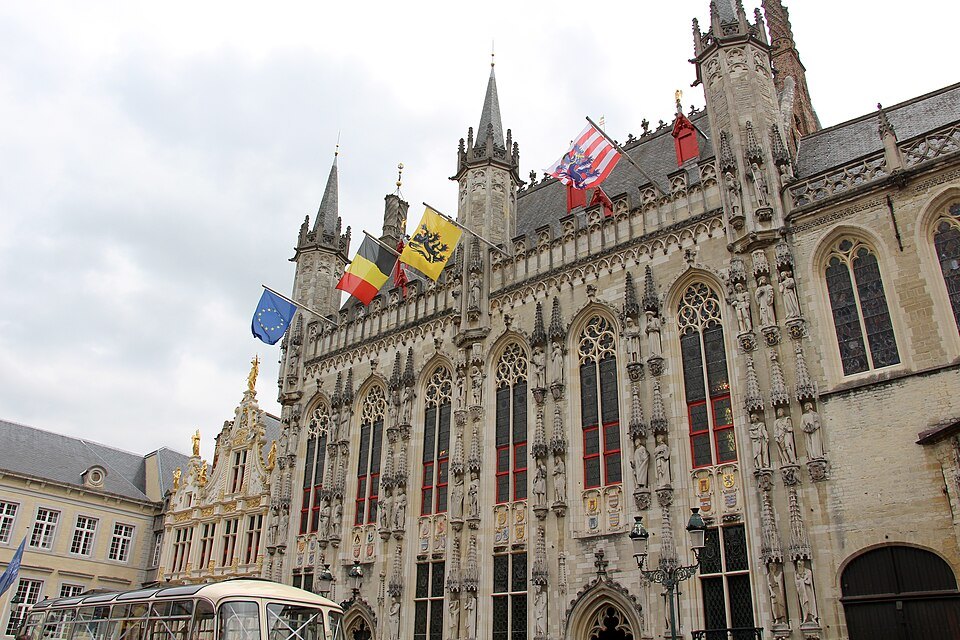
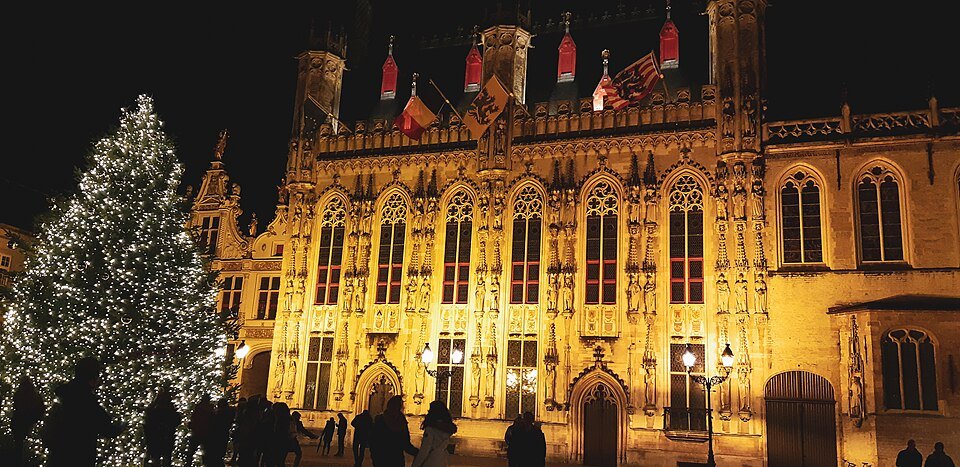
The City Hall was built between 1376 and 1421, with Count Louis of Flanders laying the foundation stone, and it is one of the oldest city halls in the former Burgundian Netherlands. Its late Gothic front, with tall windows, niches of statues and slender turrets, set a model for the city halls of Brussels, Ghent, Leuven and Oudenaarde.
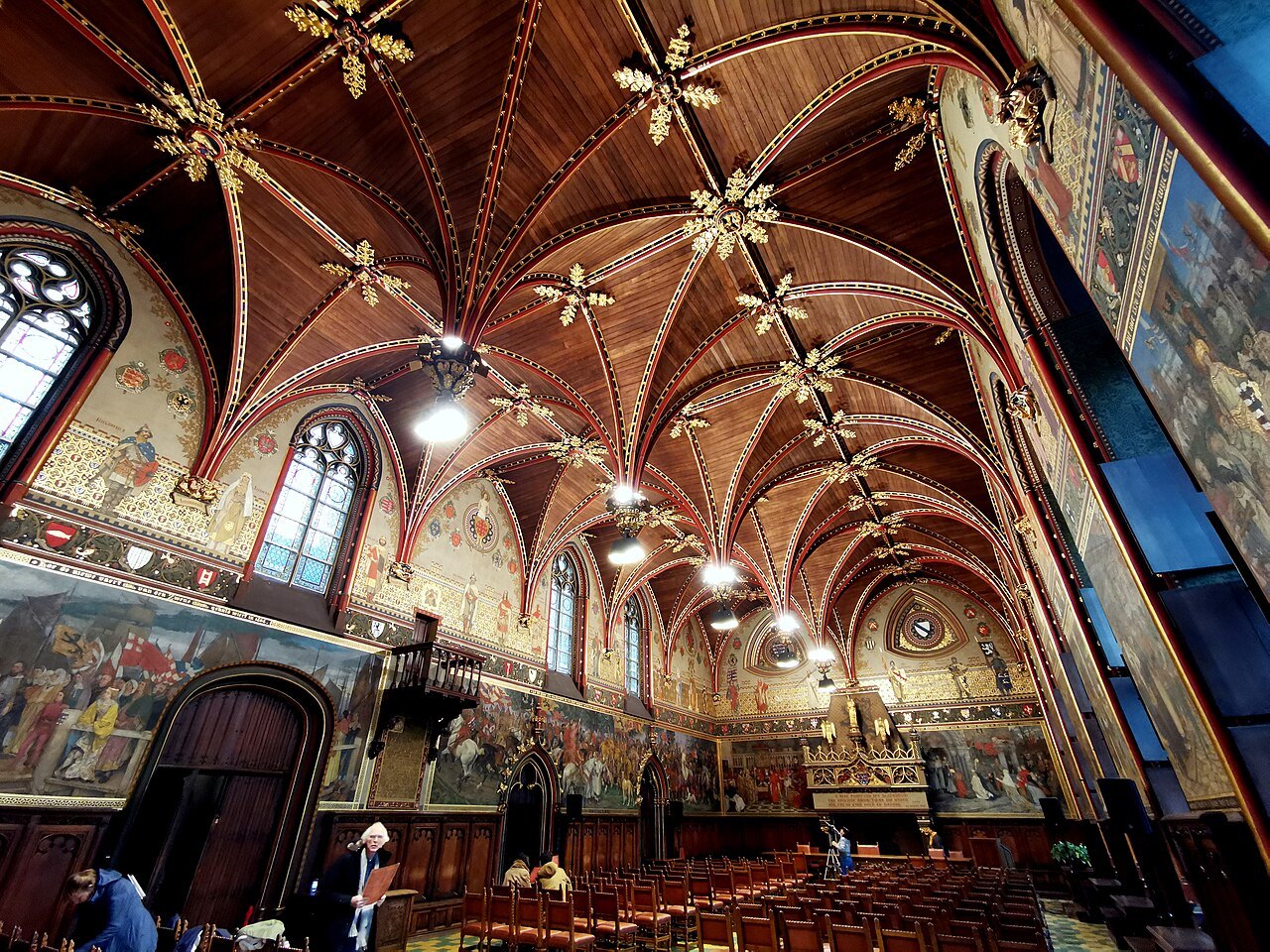
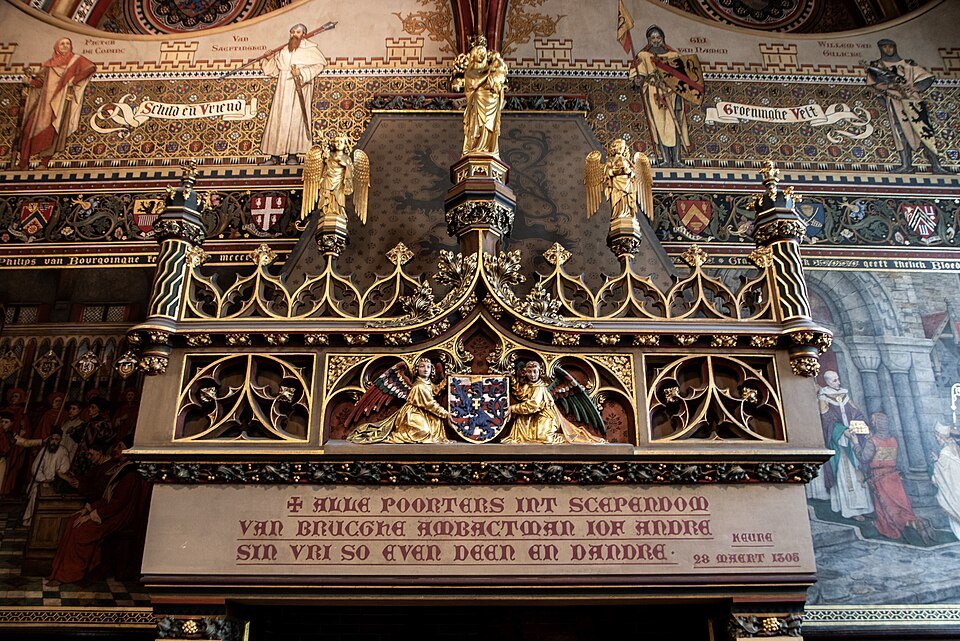
Upstairs is the Gothic Hall, created between 1895 and 1905 by combining two council chambers. Its double-vaulted timber ceiling is carved with medallions of New Testament scenes, prophets and saints, and the walls carry murals by Albrecht De Vriendt showing moments from the city's history. The hall and its fireplaces are neo-Gothic work, but the building remains the seat of the city government.
What you actually see
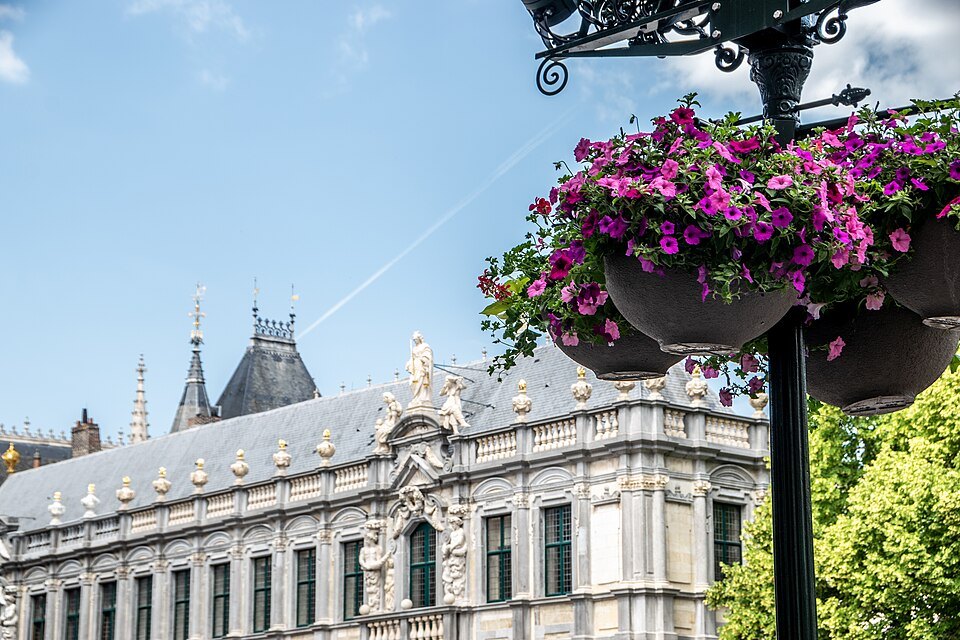
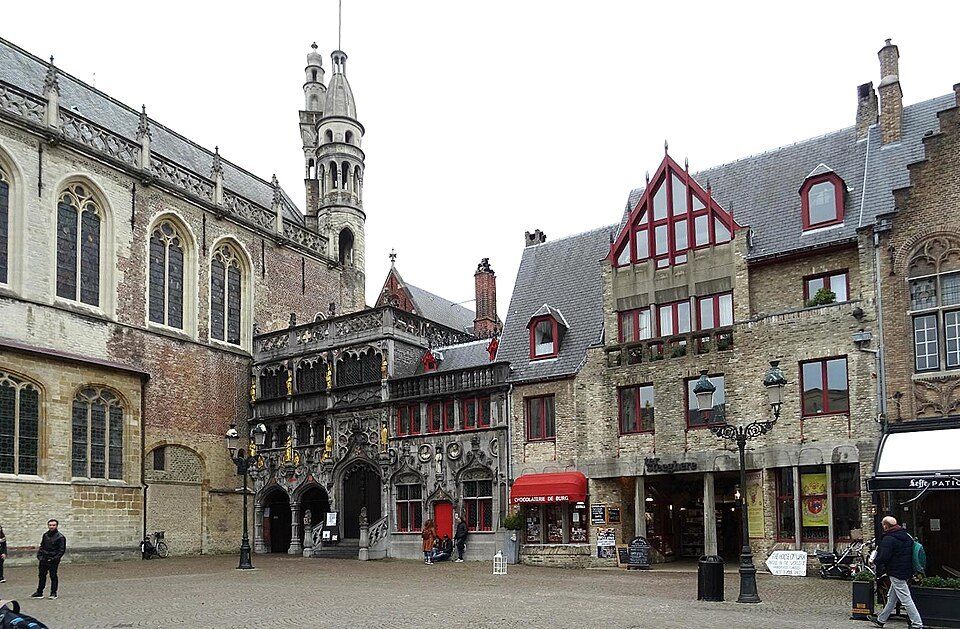
Walk round the square clockwise from the City Hall. To its right stands the Old Civil Registry, a narrow Renaissance building with gilded details, and between the two runs the arched passage of the Blinde Ezelstraat, which leads down to the canal and the fish market. In the corner to the left is the Basilica of the Holy Blood, its two chapels stacked one above the other.
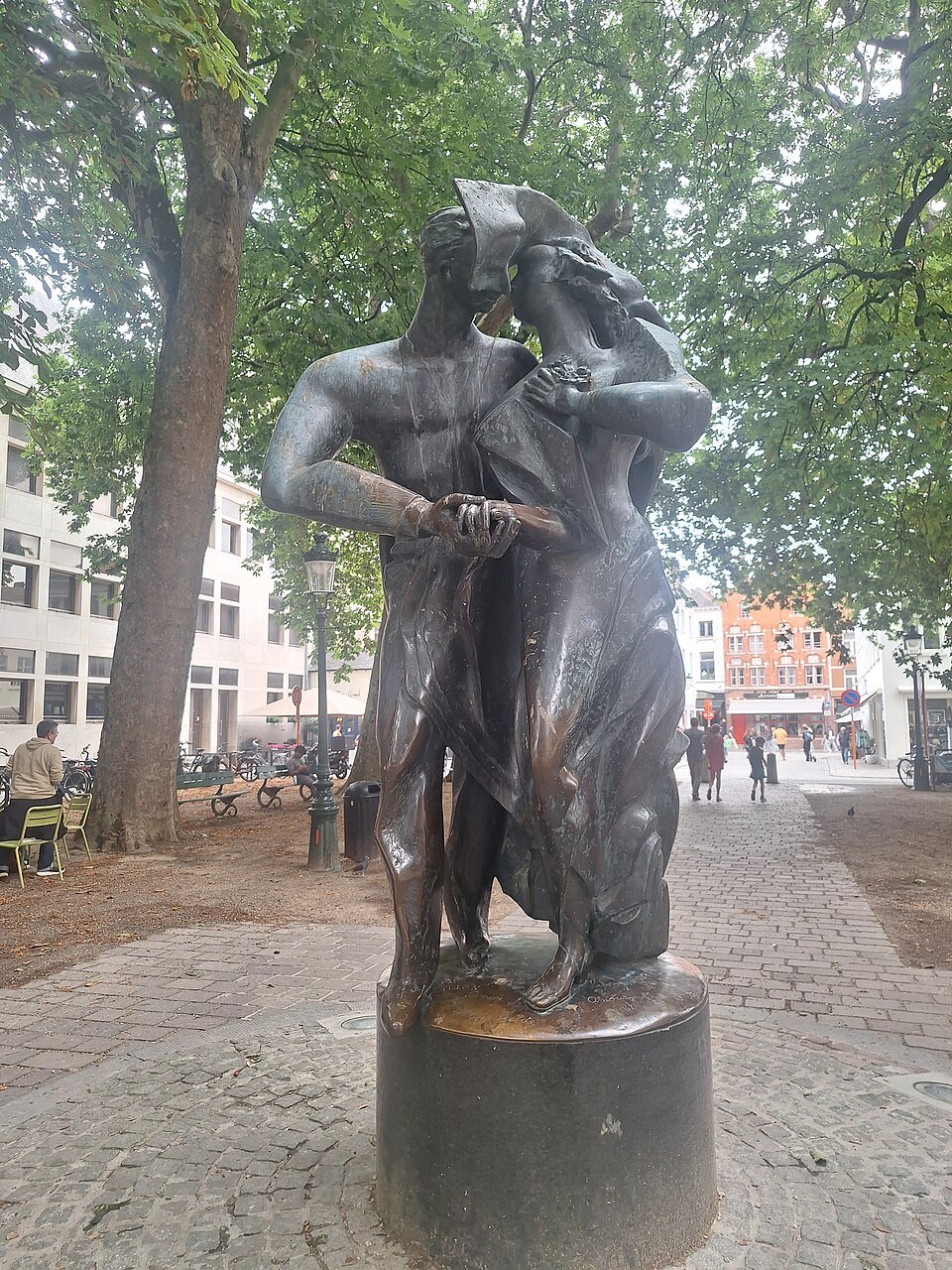
On the west side is the former Landhuis of the Brugse Vrije, the Liberty of Bruges, which governed the countryside around the city; its rear front faces the canal of the Groenerei. The north side, where the cathedral once stood, is lined with trees, the baroque Provost's House and the modern hotel, with a bronze sculpture of two lovers standing in the open space.
The square carries a darker memory too. In the night of 13 to 14 February 1967 a bomb went off at the entrance of the courthouse, shattering the stained-glass windows of the City Hall, the courthouse and the basilica. Despite long investigations, the attack was never solved. It remains one of the unexplained episodes in the recent history of the square.
How to visit
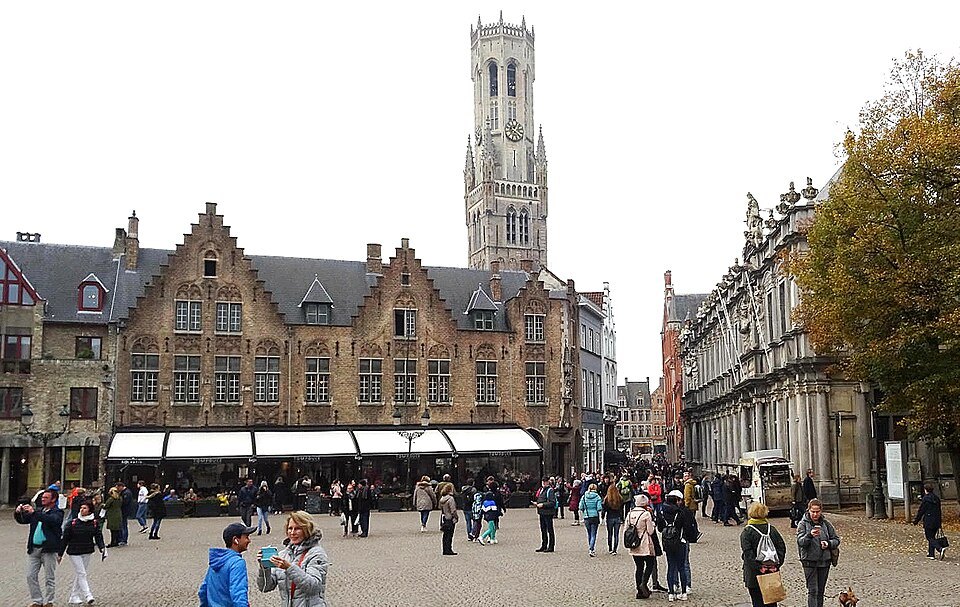
The square is always open and free, and it is worth crossing more than once: in the morning, when the sun lights the City Hall, and in the evening, when the fronts are floodlit and the day visitors have gone. Allow a quarter of an hour just to look at the buildings from the square.
The Gothic Hall inside the City Hall is visited with a ticket from Musea Brugge, and on busy days it is sensible to check the Musea Brugge site for time slots before you come. Allow half an hour for the hall and the historical rooms beside it. The Basilica of the Holy Blood has its own arrangements and is often busy in the middle of the day.
The Burg is also a stage. Open-air concerts and events are held here in summer, and the square fills for the procession of the Holy Blood; see when to come for the calendar.
Where to go next
Leave through the Blinde Ezelstraat arch and you come out on the canal at the fish market, a few steps from the Rozenhoedkaai. Walk the other way, along Breidelstraat, and you are back on the Markt under the Belfry. The quiet quays of the Groenerei begin just behind the Liberty of Bruges, and they are the best short walk from here.
Nearby
- The two squaresBasilica of the Holy BloodA double chapel in the corner of the Burg: a dark Romanesque chapel below, a richly painted Gothic Revival chapel…Read the page
- The two squaresThe MarktThe great open square at the center of Bruges, framed by gabled guild-style houses, the neo-Gothic Provincial Court and…Read the page
- The merchants' northGroenereiA curving stretch of canal and quay behind the Burg, lined with almshouses, the Renaissance back of the Liberty of…Read the page