Why it matters
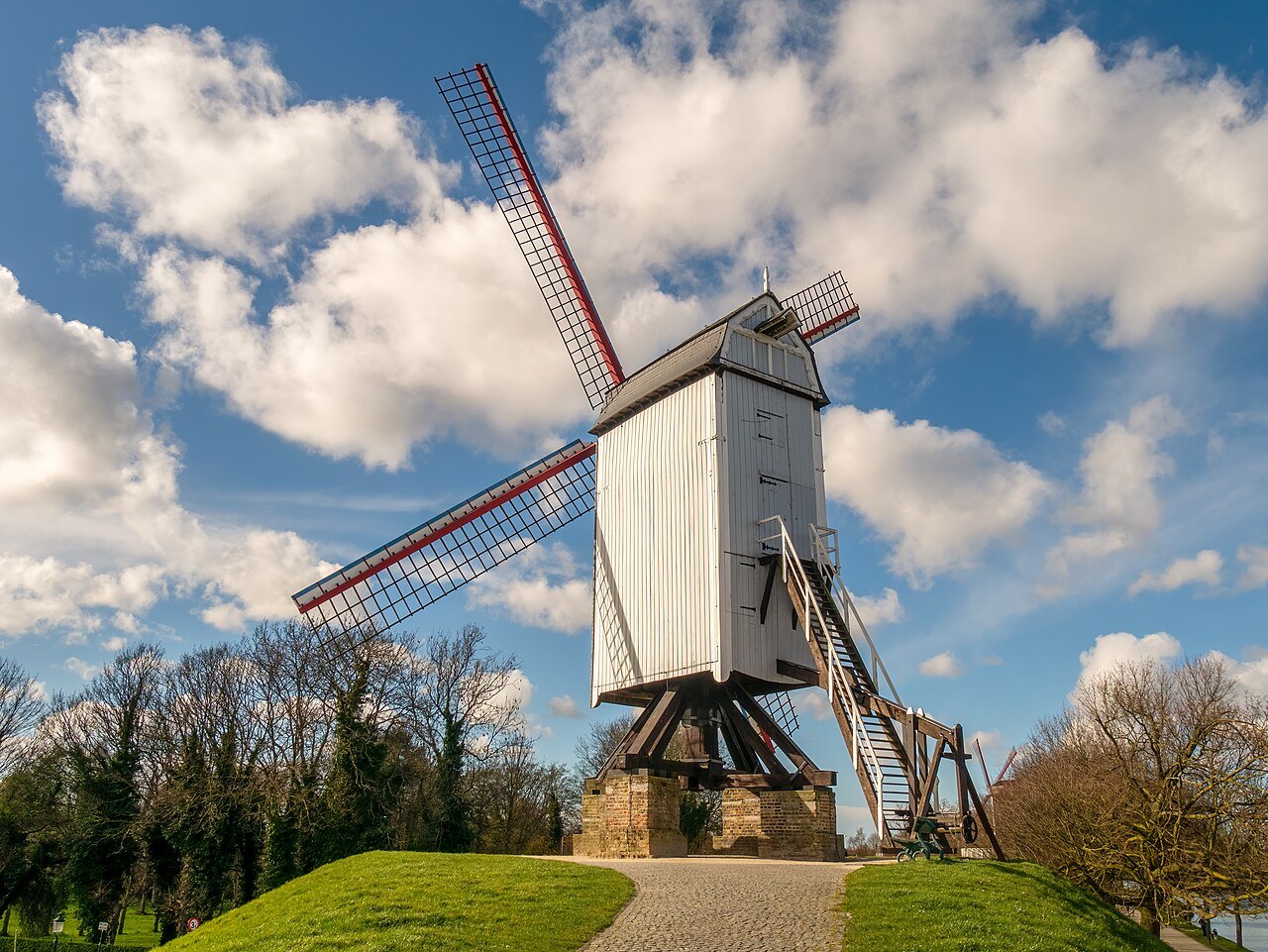
On the eastern edge of the old town the ramparts rise into a line of grassy mounds, and on top of them stand wooden windmills with their sails against the sky. It is one of the most picturesque walks in Bruges, and a surprise for visitors who have spent their time among stone and brick in the center.
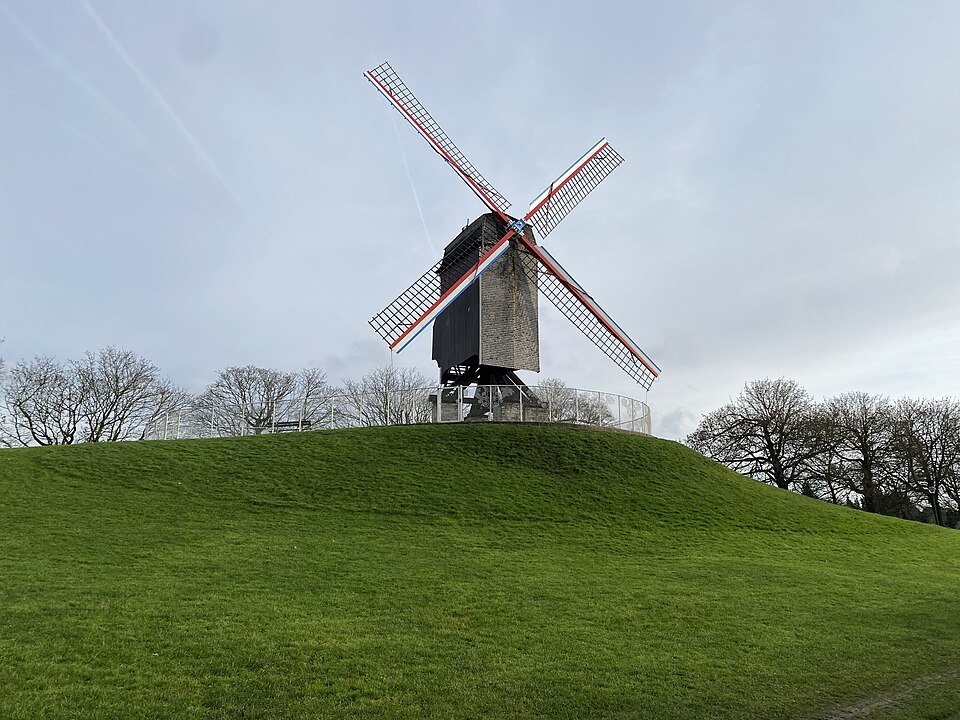
The mills are a reminder that medieval Bruges needed to feed itself. Grain was ground at the city's edge, where the wind blew freely over the flat land, and the ramparts gave the mills height. Four of them stand along the Kruisvest today, and two can be visited inside, with ladder-like stairs leading up into the working body of the mill.
The walk itself costs nothing beyond time, since the ramparts are a public park open to anyone. It works well as a detour from the center, a change of pace from the canals and gabled squares covered under /sights/, and a chance to see Bruges from slightly above the roofline rather than from the street.
From many mills to four
The mills disappeared as the city changed. When the ramparts were turned into a landscaped park in the nineteenth century, the old mills were removed one by one, because steam-powered mills had made them obsolete elsewhere in the region. What stands on the Kruisvest now is partly survival and partly restoration, with mills brought in from the Flemish countryside to keep the skyline recognizable.
The ramparts themselves were built in the city's second expansion, between 1297 and 1301, and in 1782 the city decided to dismantle the fortifications that had defined its edge for centuries. Between 1853 and 1915 a series of projects, some drawn by landscape architects from Leuven and Ghent, turned the old defensive line into the park walked today, and the whole ring was protected as a cityscape in 2016.
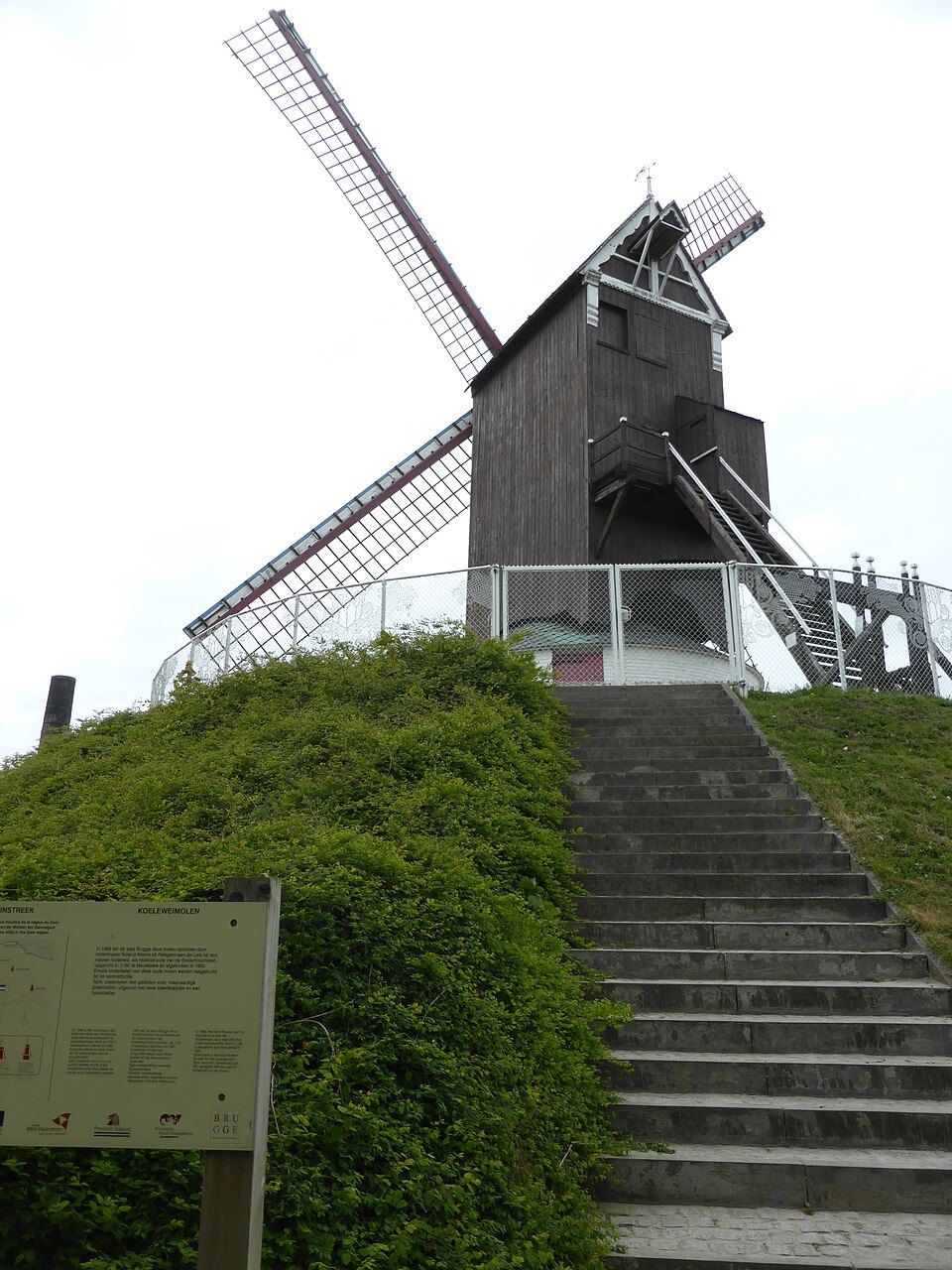
Only one mill is a Bruges original still standing on its own site. The others were brought from villages elsewhere in Flanders, one in 1911, one in 1970 and one rebuilt in 1996, so the line of sails seen today is partly history and partly a deliberate recreation assembled piece by piece.
The four mills
Sint-Janshuismolen was built in 1770 by the bakers' guild as a grain mill, and the year is carved into its iron beam. It is the third mill on the site: an earlier one from around 1550 was blown over around 1744. The city bought the mill on 3 April 1914 from the Gevaert family, and after restoration in 2001, timed for the year Bruges was European Capital of Culture in 2002, it became a museum mill run by Musea Brugge.
Koeleweimolen is a reconstruction of the Bosterhoutmolen, built in 1765 and 1766 at Meulebeke in the countryside. That mill worked until 1958 and was then dismantled to make room for a road that was never built. The pieces were sold to the city of Bruges, which rebuilt the mill on the Kruisvest in 1996 and gave it its present name. It functions as a grain mill and museum.
Bonne Chiere was moved here in 1911 from Olsene, taking the place of a mill of 1487, and De Nieuwe Papegaai came from Beveren-aan-de-IJzer in 1970. Neither is set up for visitors to climb, but both complete the line of sails along the rampart and are worth the walk, best seen from the path at their foot where the full wooden body is visible.
What you actually see
The mills are post mills: the whole wooden body, with the sails and the millstones inside, sits on a single massive post and is turned to face the wind by a long tail beam pushed round at ground level. Each stands on its own grassy mound, reached by a path or steps, and visitors can walk right up to the base and look up at the sails from underneath.
Inside a museum mill the climb is up steep ladder-like stairs into the body of the mill, where the millstones, the gears and the sack hoist sit close together in a surprisingly small space. When the miller has the sails turning, the whole structure creaks and shifts, and the grinding mechanism can be watched in motion rather than read about on a panel.
From the top of the mounds there are views over the outer canal to one side and the roofs and towers of Bruges to the other, a vantage point that few other spots in the city offer without a climb like the one at the /belfry/. On a clear day the flat countryside beyond the ring is visible too, the same open land the mills were built to catch the wind over.
Visiting the two museum mills
Sint-Janshuismolen and Koeleweimolen are both run by Musea Brugge, and both have periods and days set for visitors, which change through the year. Check the Musea Brugge site, or ask at one of the city's visitor information points, before building a plan around either mill, since neither can be assumed to be ready to climb on a given day.
The stairs inside are steep, narrow and close to vertical, with no other way up, so they are not suitable for small children, for anyone unsteady on their feet, or for visitors who find tight spaces difficult. There is no lift and no alternative route to the upper floor.
Choose a breezy day if possible: the sails are more likely to be turning, and the Kruisvest is at its best with clouds moving fast over the flat land beyond the mounds. A still, airless day can mean motionless sails on all four mills, which is still worth seeing but less of a spectacle.
Combining the walk
The walk along the Kruisvest past all four mills takes about twenty minutes at an easy pace, without stopping to go inside either museum mill. Add time for the climb if visiting one, and more again for photographs from the mounds, since the light changes quickly along this open stretch of park.
Combine the mills with the Kruispoort at the southern end of the Kruisvest, one of the surviving city gates, and the Jerusalem Church a few streets into town, both an easy extension of the same outing. Together they make a half-day loop that stays largely outside the busiest central streets.
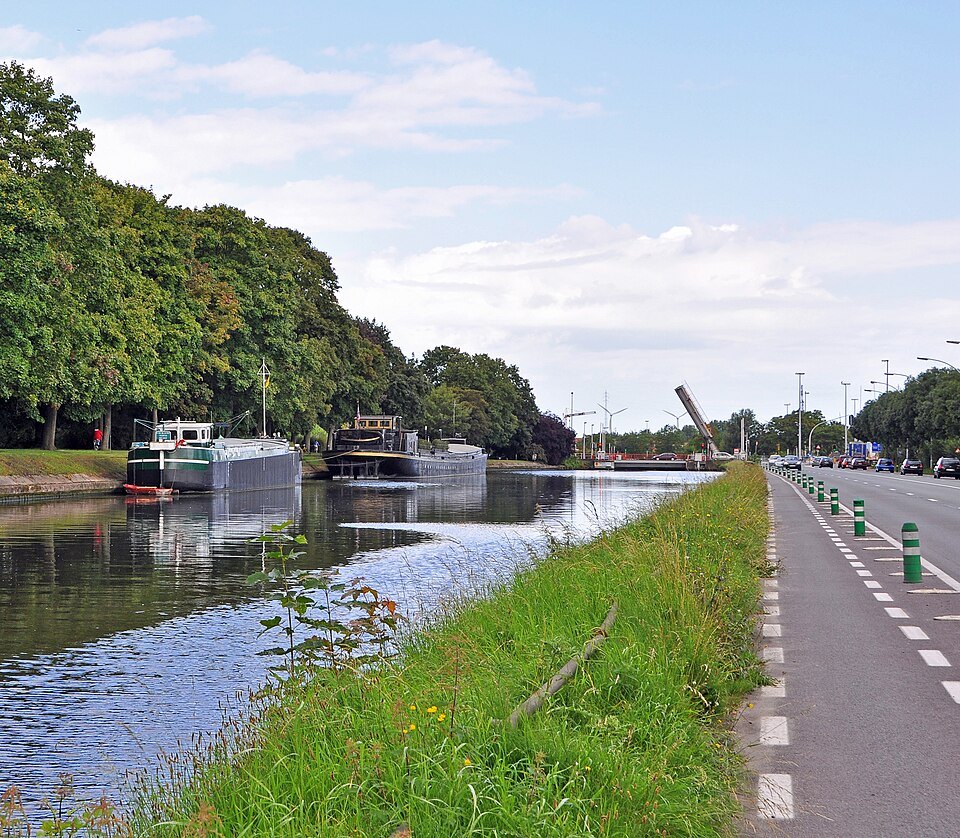
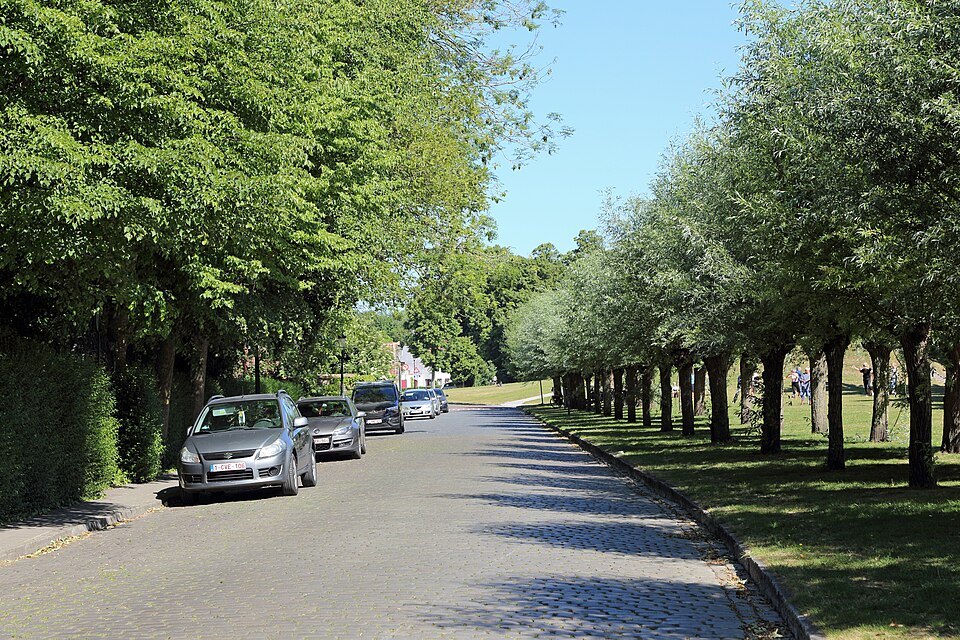
The windmills are the highlight of the green ring that circles the old town, and the Kruisvest is only one stretch of it. Join the ramparts from the center in about fifteen minutes by walking east along Langestraat to the Kruispoort, or start a full loop at the Minnewater in the south and see /itineraries/ for where this walk fits into a longer stay in Bruges.
Read next
- The BurgWalking round the Burg, from the gilded Old Civil Registry to the lost cathedral under the hotelA walking guide to the Burg, from the gilded Old Civil Registry to the vanished cathedral beneath the hotel.Read
- Day TripsCycling to Damme along the canal is the best half day out from BrugesHow to ride from Bruges to Damme along the Damse Vaart, what to see in the small town that was once Bruges's port, and how to come back by paddle steamer.Read
- ItinerariesSeeing Bruges in a single day without spending it in queuesA walking plan for one day in Bruges that puts the famous squares early and late, the museums in the middle, and keeps lines and crowds to a minimum.Read