Home · Sights · The Kruisvest Windmills
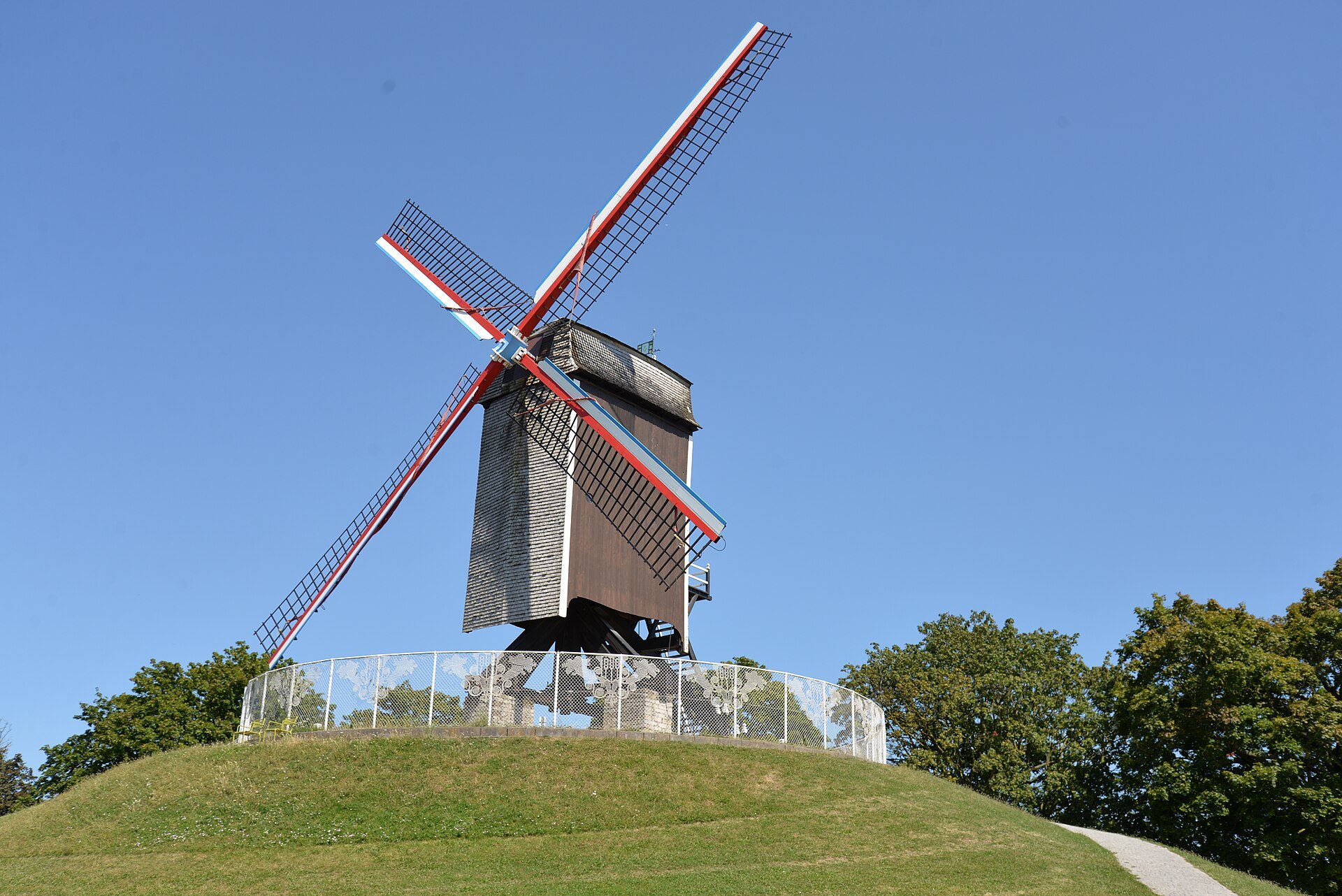
Four wooden post mills standing on grassy mounds along the eastern ramparts of Bruges, the survivors of the many that once turned around the city, two of them open as working museums.
The parts to look at
- IBonne ChiereThe mill nearest the Kruispoort, brought from Olsene in 1911
- IISint-JanshuismolenBuilt by the bakers' guild in 1770, a museum mill
- IIIKoeleweimolenA reconstructed eighteenth-century mill that still grinds
- IVDe Nieuwe PapegaaiMoved here from Beveren-aan-de-IJzer in 1970
- VThe moundsGrassy banks raised so the sails catch the wind above the trees
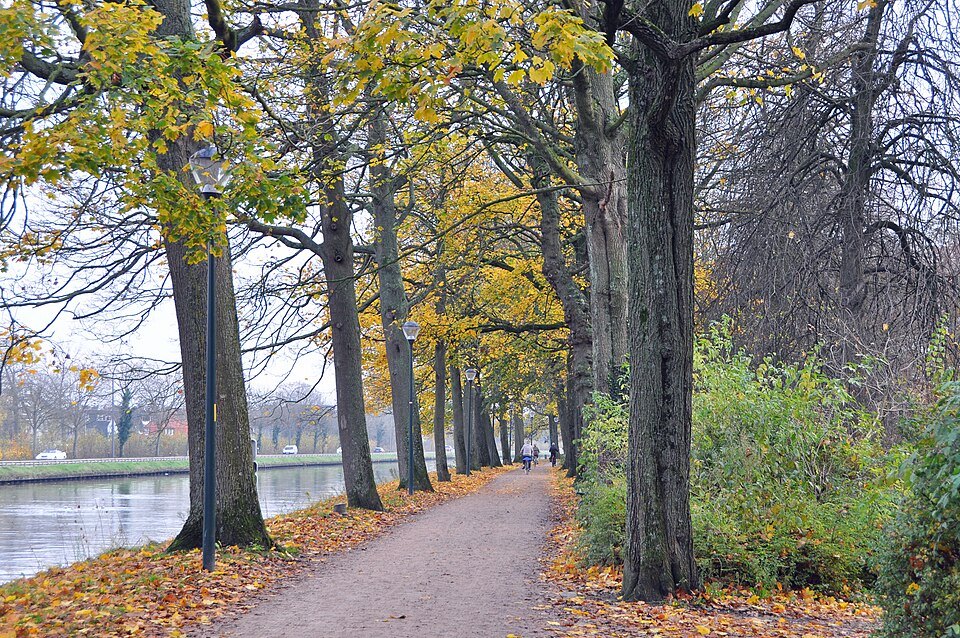
- VIThe KruisvestThe green rampart path running beside the outer canal
Why it matters
On the eastern edge of the old town the ramparts rise into a line of grassy mounds, and on top of them stand wooden windmills with their sails against the sky. It is one of the most picturesque walks in Bruges, and a surprise for visitors who have spent their time among stone and brick in the center.
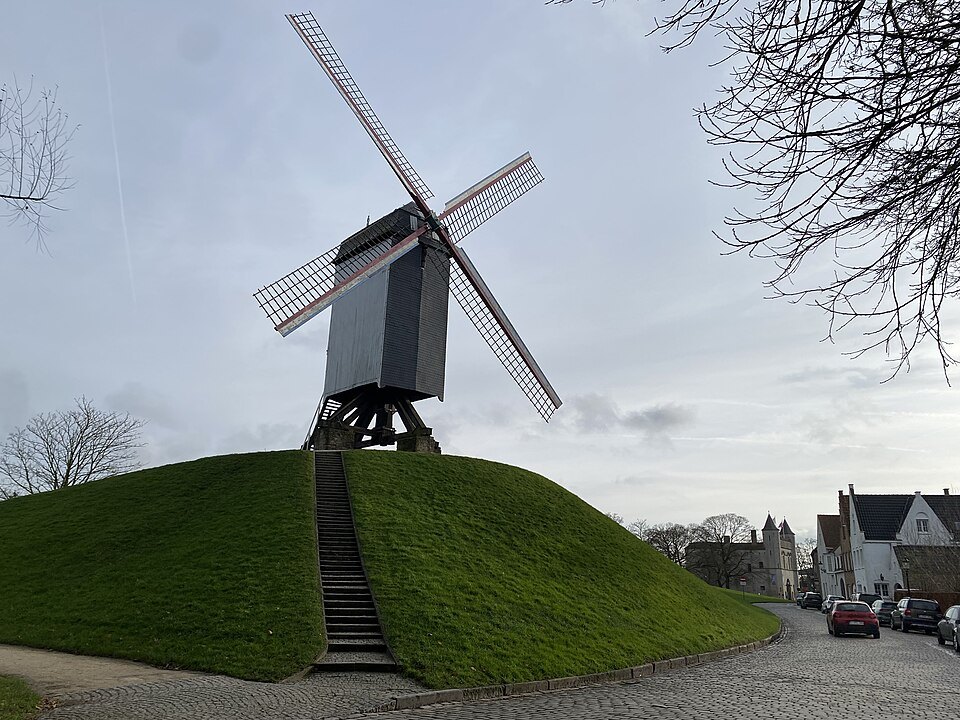
The mills are a reminder that medieval Bruges needed to feed itself. Grain was ground at the city's edge, where the wind blew freely over the flat land, and the ramparts gave the mills height. Four of them stand along the Kruisvest today, and two can be visited inside.
From many mills to four
The mills disappeared as the city changed. When the ramparts were turned into a landscaped park in the nineteenth century, the old mills were removed one by one; steam-powered mills had made them obsolete. What stands on the Kruisvest now is partly survival and partly restoration, with mills brought in from the Flemish countryside.
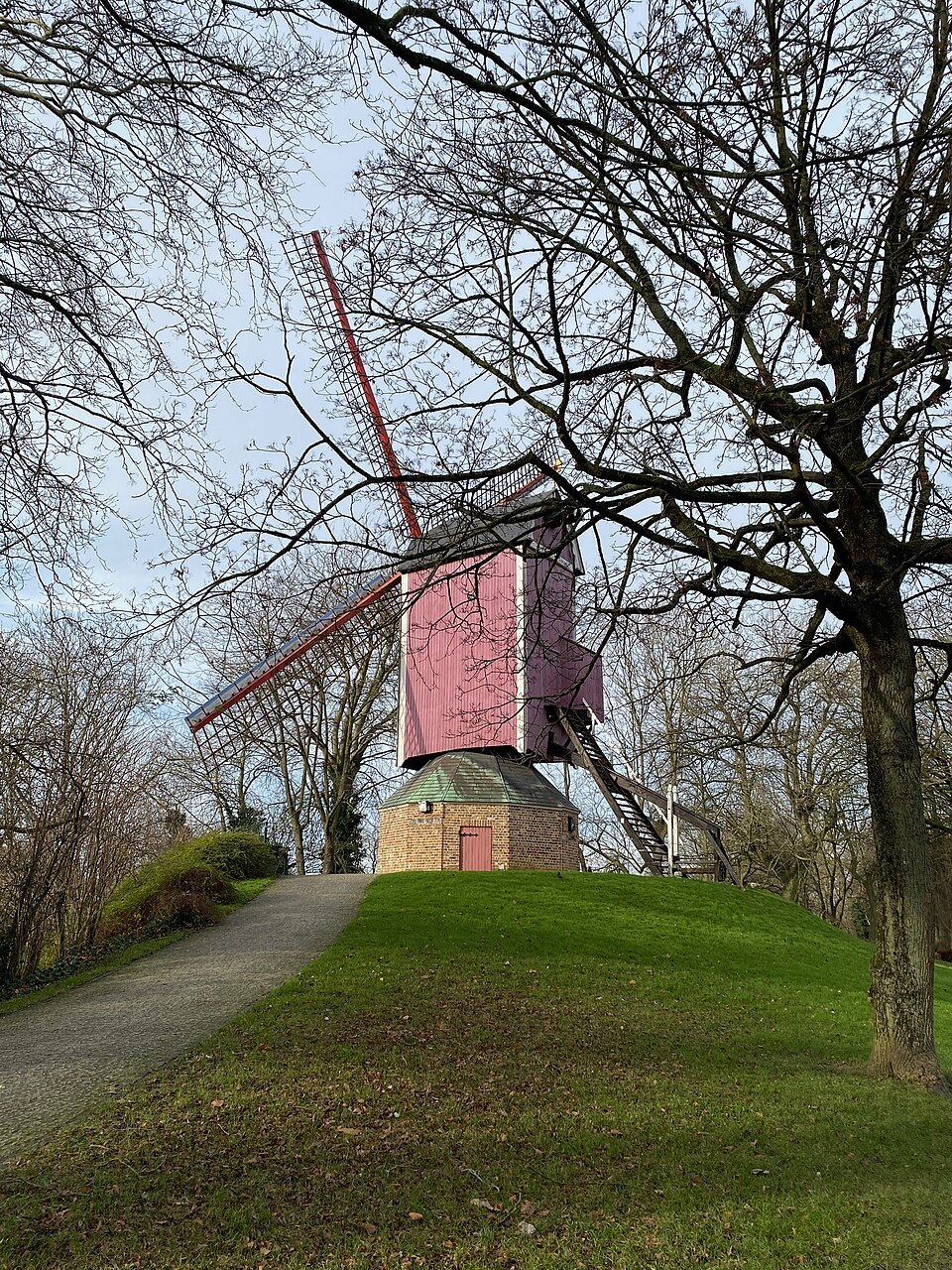
The ramparts themselves were built in the city's second expansion, between 1297 and 1301, and in 1782 the city decided to dismantle the fortifications. Between 1853 and 1915 a series of projects, some drawn by landscape architects from Leuven and Ghent, turned the old defensive line into the park you walk through today, and the whole ring was protected as a cityscape in 2016.
Only one mill is a Bruges original on its own site. The others were brought from villages elsewhere in Flanders, one in 1911, one in 1970 and one rebuilt in 1996, so the line of sails you see is partly history and partly a deliberate recreation.
The four mills
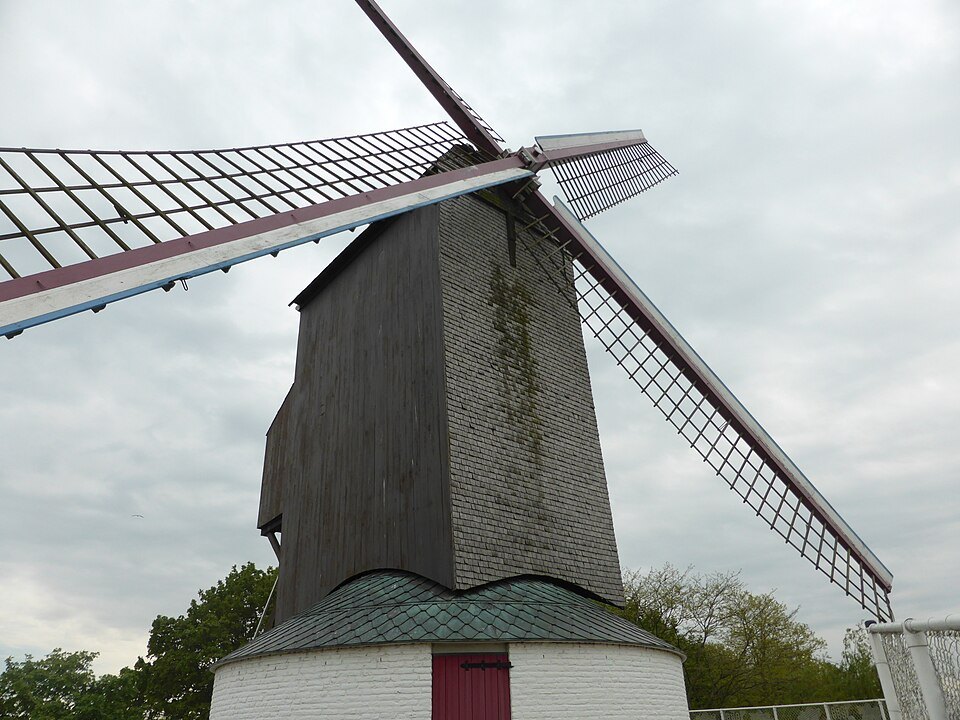
Sint-Janshuismolen was built in 1770 by the bakers' guild as a grain mill, and the year is carved into its iron beam. It is the third mill on the site: an earlier one from around 1550 was blown over around 1744. The city bought the mill on 3 April 1914 from the Gevaert family, and after restoration in 2001, for the year when Bruges was European Capital of Culture in 2002, it became a museum mill run by Musea Brugge.
Koeleweimolen is a reconstruction of the Bosterhoutmolen, built in 1765 and 1766 at Meulebeke in the countryside. That mill worked until 1958 and was then dismantled to make room for a road that was never built. The pieces were sold to the city of Bruges, which rebuilt the mill on the Kruisvest in 1996 and gave it its present name. It is a post mill that still works as a grain mill and museum.
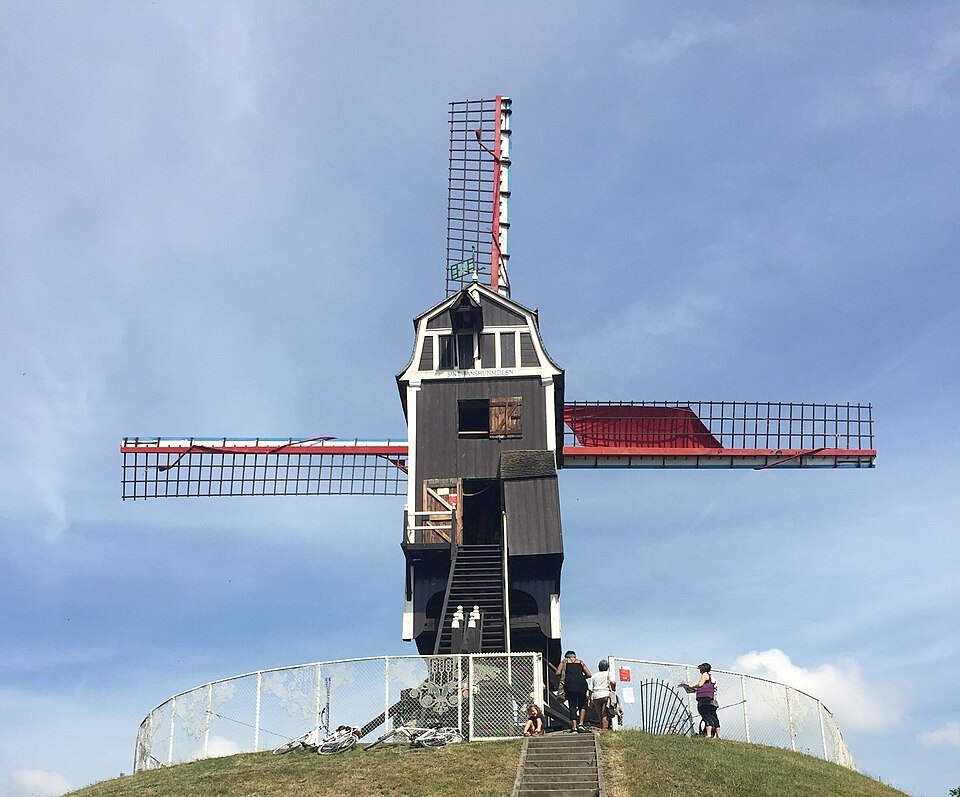
Bonne Chiere was moved here in 1911 from Olsene, taking the place of a mill of 1487, and De Nieuwe Papegaai came from Beveren-aan-de-IJzer in 1970. Both complete the line of sails along the rampart and are best seen from the path at their foot.
What you actually see
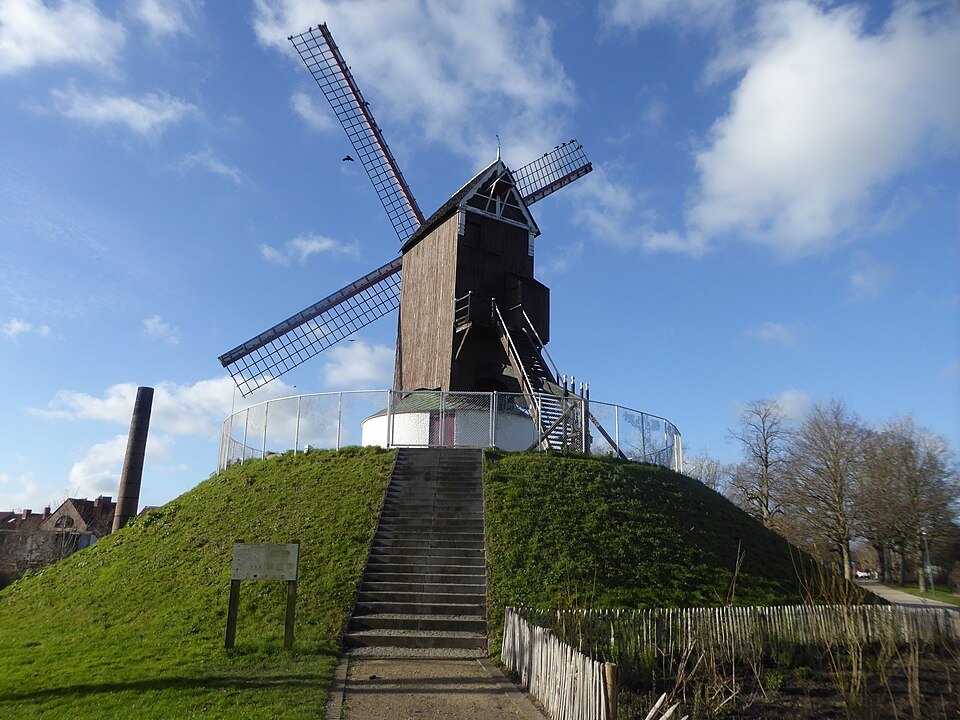
The mills are post mills: the whole wooden body, with the sails and the millstones inside, sits on a single massive post and is turned to face the wind by a long tail beam pushed round at ground level. Each stands on its own grassy mound, reached by a path or steps, and you can walk right up to the base.
Inside a museum mill you climb steep ladder-like stairs into the body, see the millstones, the gears and the sack hoist, and feel the building creak as the sails turn when the miller has them working. From the top of the mounds there are views over the outer canal to one side and the roofs and towers of Bruges to the other.
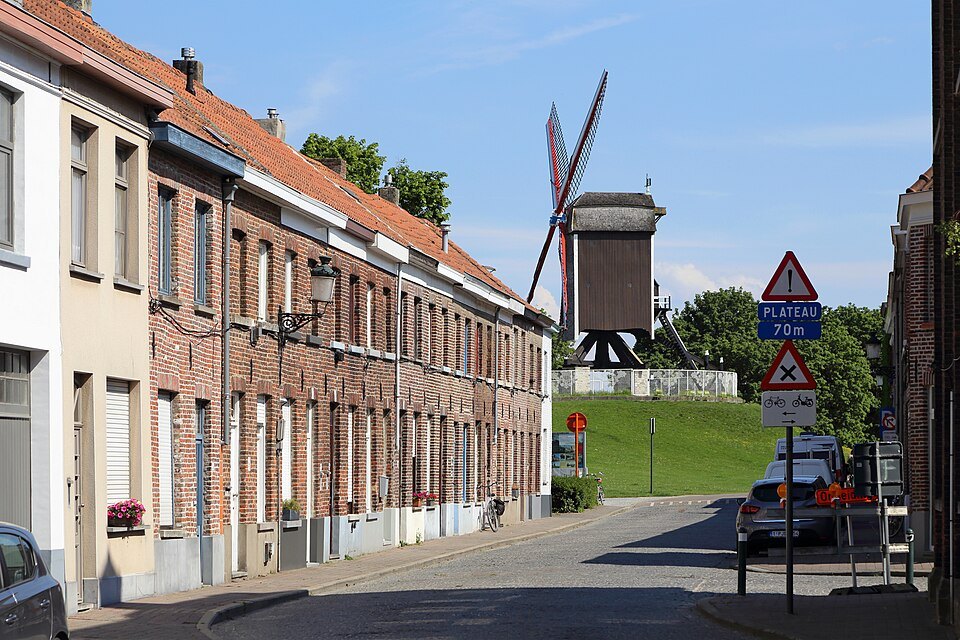
The contrast between the four is part of the interest. Sint-Janshuismolen belongs to the city's own guild history, Koeleweimolen shows how a country mill can be saved from a road scheme, and the two others show how Bruges gathered mills from its region to keep this stretch of the ramparts looking the way it did when grain was still ground here.
How to visit
The ramparts are a public park, free and open, and the walk along the Kruisvest past all four mills takes about twenty minutes. The two museum mills are run by Musea Brugge, whose site gives the periods and days when they can be visited; check before planning a visit around them.
The stairs inside the mills are steep, narrow and close to vertical, so they are not suitable for small children or anyone unsteady on their feet, and there is no other way up.
Choose a breezy day if you can: the sails are more likely to be turning, and the Kruisvest is at its best with clouds moving over the flat land. Combine the mills with the Kruispoort at the southern end of the Kruisvest and the Jerusalem Church a few streets into town.
Walking the ramparts
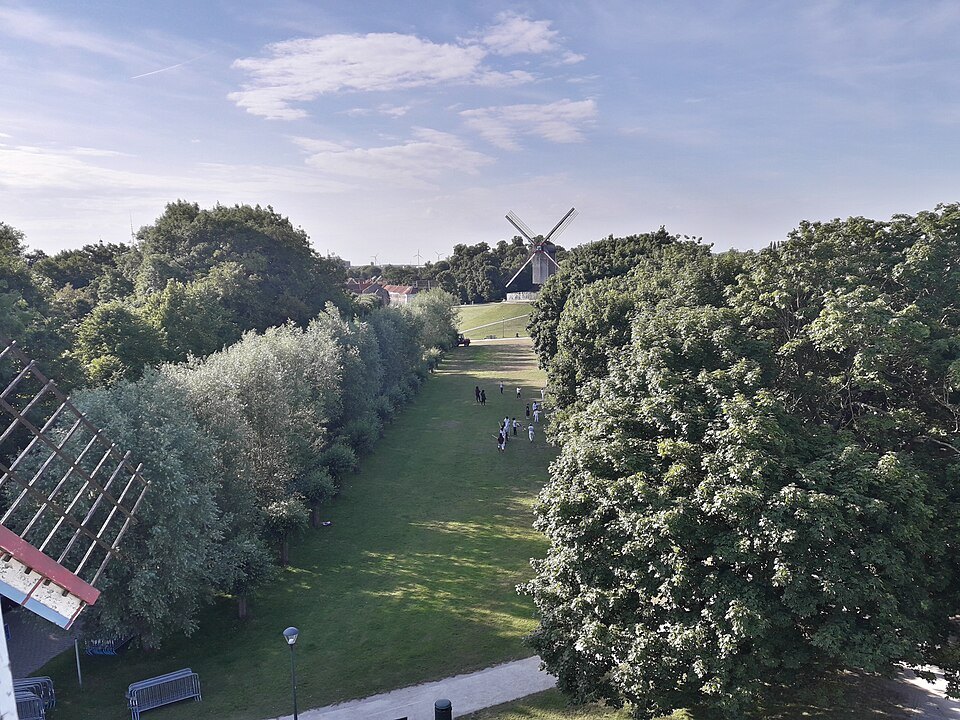
The windmills are the highlight of the green ring that circles the old town. You can follow the ramparts all the way round, past the city gates, or join them from the center in about fifteen minutes by walking east along Langestraat to the Kruispoort. For a complete loop, start at the Minnewater in the south, and see itineraries for where it fits into a longer stay.
Nearby
- East to the rampartsThe City GatesFour gates survive from the wall Bruges built from 1297, standing on the green ring of ramparts: the Kruispoort, the…Read the page
- East to the rampartsJerusalem ChurchA private chapel built by the Adornes family after a pilgrimage to Jerusalem, inspired by the Church of the Holy…Read the page
- The merchants' northGroenereiA curving stretch of canal and quay behind the Burg, lined with almshouses, the Renaissance back of the Liberty of…Read the page