Home · Sights · St. Salvator's Cathedral
The oldest parish church in Bruges, made a cathedral only in 1834, with a tower rebuilt after a fire and an interior full of works rescued from the demolished cathedral of St. Donatian.
The parts to look at
Why it matters
Walk west from the Markt along Steenstraat and a massive brick tower appears above the shopping street. This is St. Salvator's Cathedral, the seat of the bishop of Bruges. It is less visited than the Church of Our Lady, which makes it one of the calmer great interiors in the city, and it is packed with art.
Its story is unusual. For most of its history it was simply the city's leading parish church; it became the cathedral only in the nineteenth century, after the old cathedral of St. Donatian on the Burg had been torn down. Much of what you see inside came from that lost building.
From chapel to cathedral
Tradition credits St. Eligius with a chapel here around 646, but the historical evidence points to a ninth-century foundation, and the chapel became a parish church in 1089. After fires in 1116 and 1166 a Romanesque church was built and burned, and the lower part of the tower still holds stonework from that period.
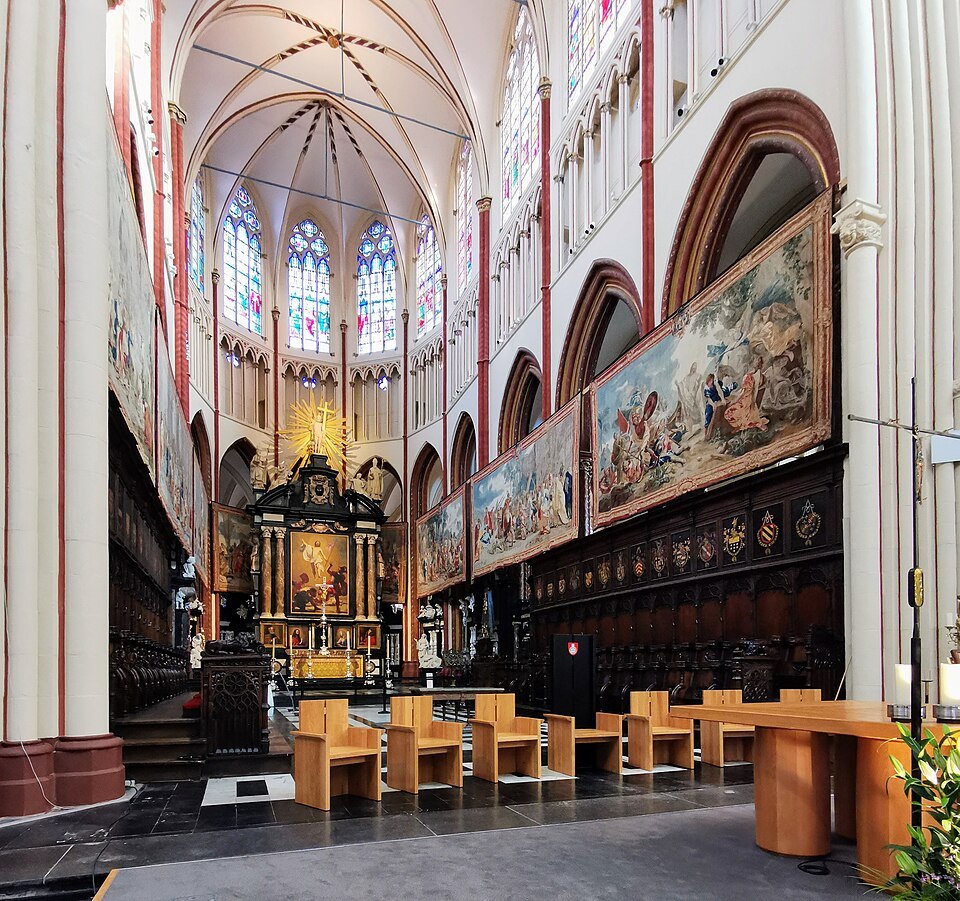
The church was rebuilt in Gothic style between 1250 and 1350. After another fire in 1358 it was enlarged again between 1480 and 1550, when the ambulatory and five radiating chapels were added around the choir by Jan van den Poele.
When the diocese of Bruges was restored in 1834, St. Salvator's became the cathedral, replacing St. Donatian's, which had been demolished in 1799. It was given works of art salvaged from its predecessor, and it was raised to the rank of minor basilica in 1921.
The tower
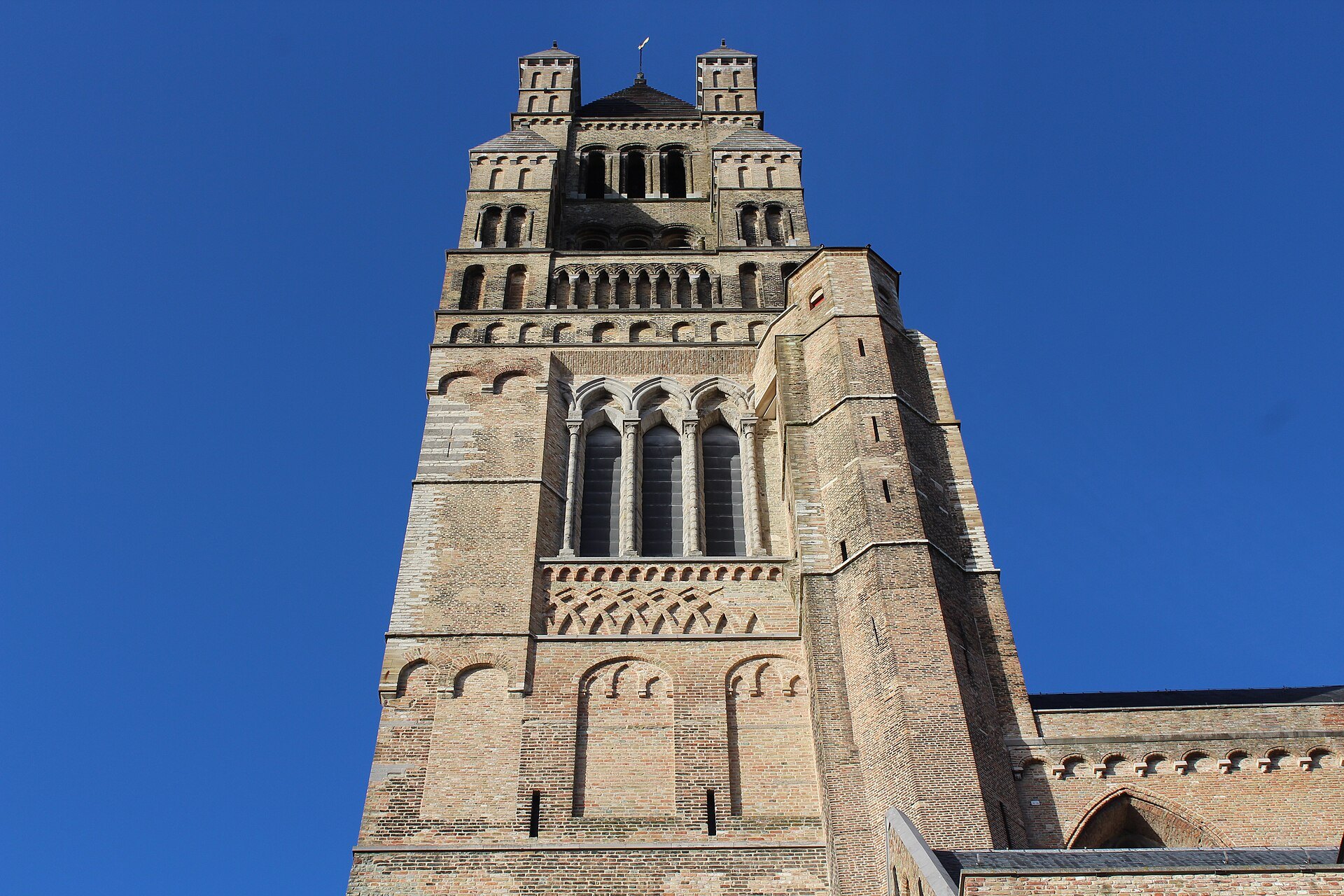
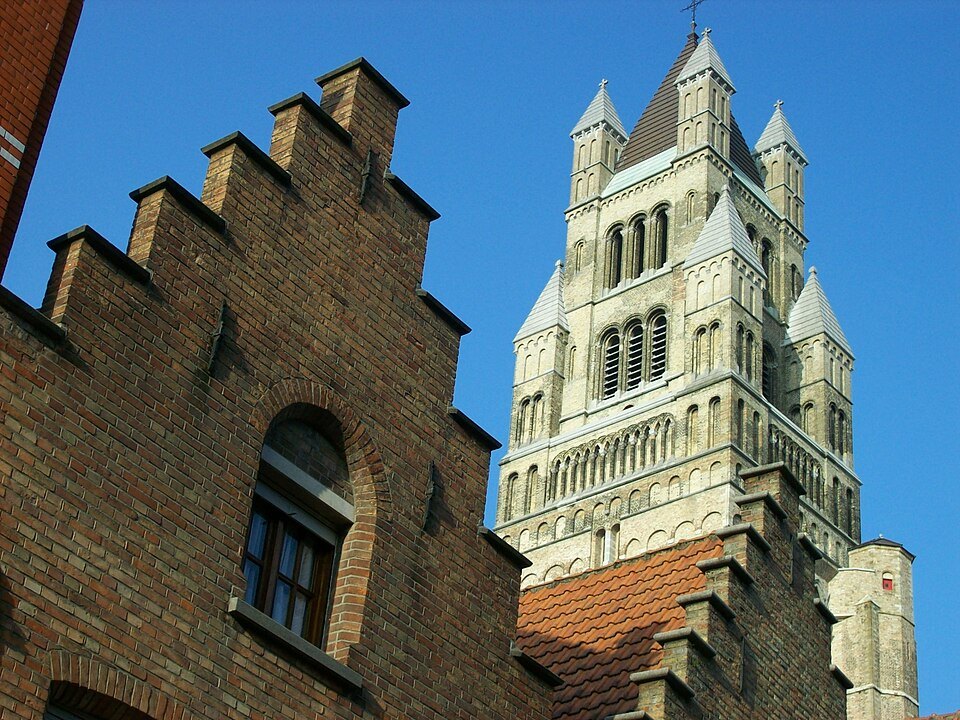
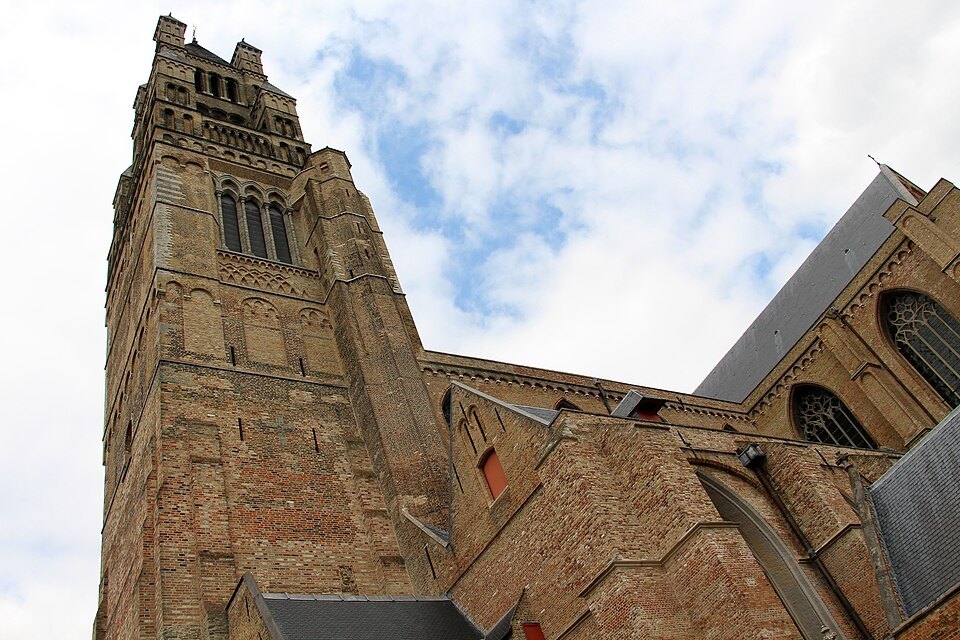
In 1839 a fire badly damaged the tower. It was rebuilt between 1843 and 1846 in a neo-Romanesque style under the English architect Robert Chantrell and the local builder Pierre Buyck, and the architect Eugène Carpentier added the spire in 1871. Today the tower stands 79 meters tall.
The loss of St. Donatian's left a gap at the heart of the diocese. It had been the cathedral since 1559, when Bruges became a bishopric, and it had held the graves and treasures of the city's elite. When the bishops returned in the nineteenth century, St. Salvator's, the oldest parish in the city, was the natural choice to take its place.
The result is a tower unlike any other in Bruges: heavy, round-arched and more fortress than spire, a nineteenth-century idea of the Middle Ages set on genuinely medieval foundations. It is best seen from the little square behind the cathedral or from the top of the Belfry.
Reading the tower from outside
Stand back from the tower and you can read its history in layers. At the foot is the oldest masonry, surviving from the Romanesque church that burned in 1166. Above it rises the brick of the Gothic rebuilding, and at the top the round-arched stages added by Chantrell after the fire of 1839, finished with Carpentier's spire of 1871.
Those layers explain why the tower looks so different from the slender Gothic spires elsewhere in Bruges. It is a medieval base wearing a Victorian crown, and once you know that, it becomes one of the more interesting buildings in the skyline rather than simply the heaviest.
What you actually see
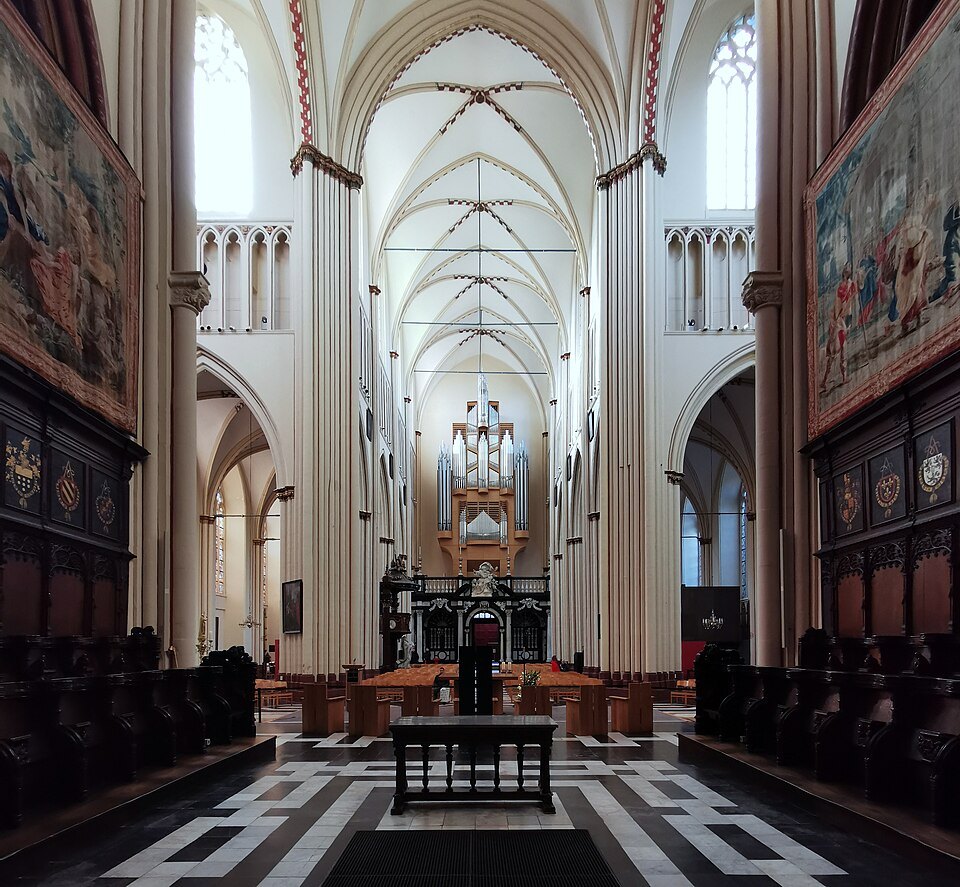
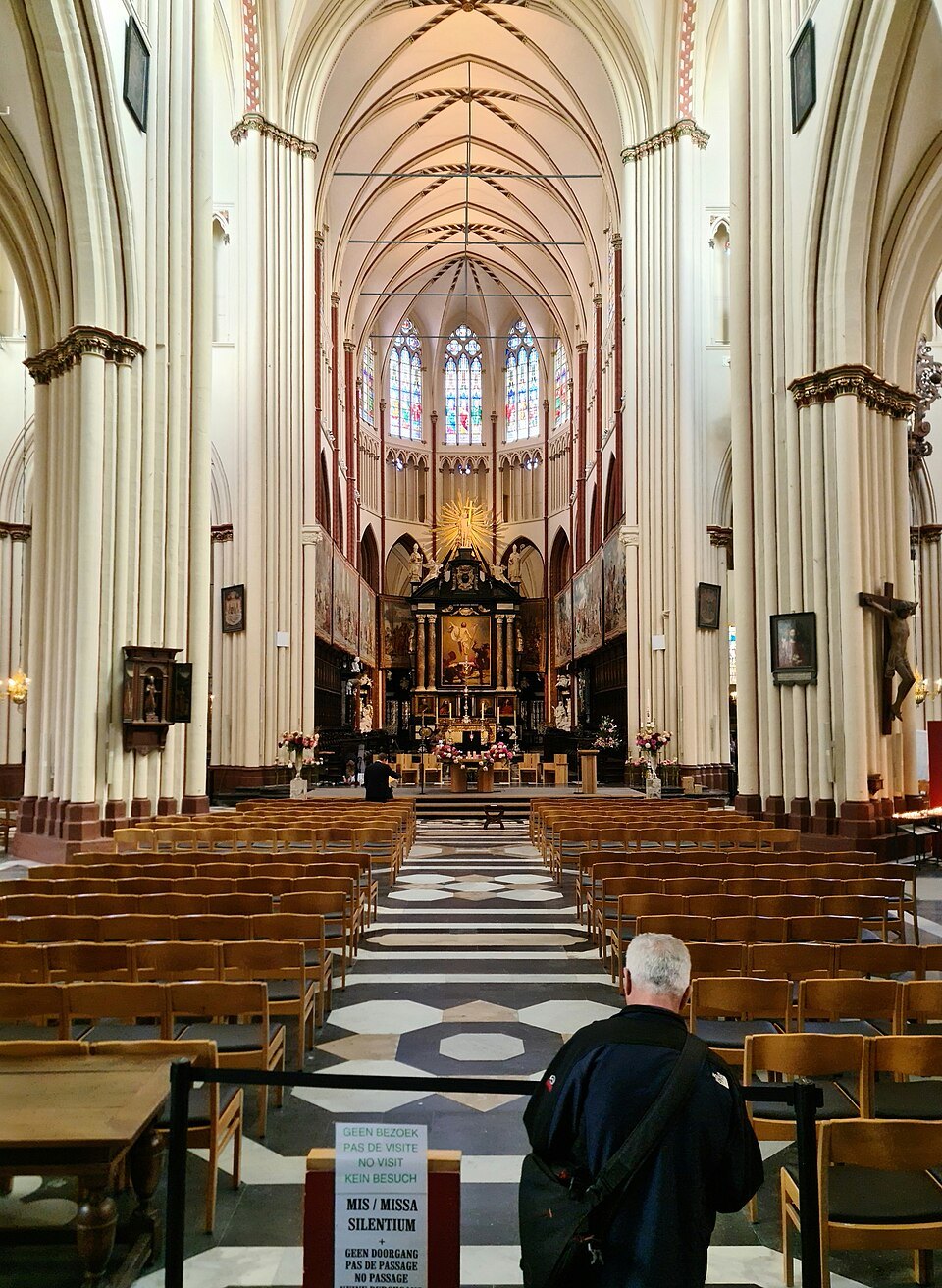
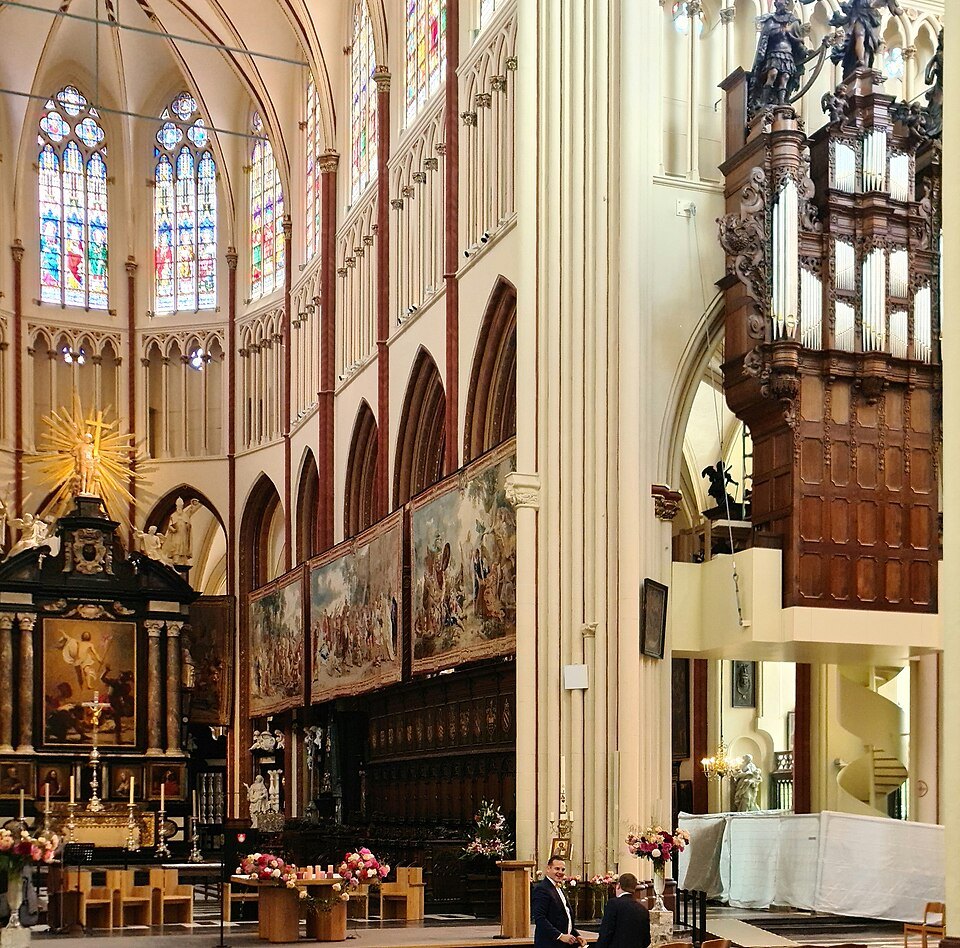
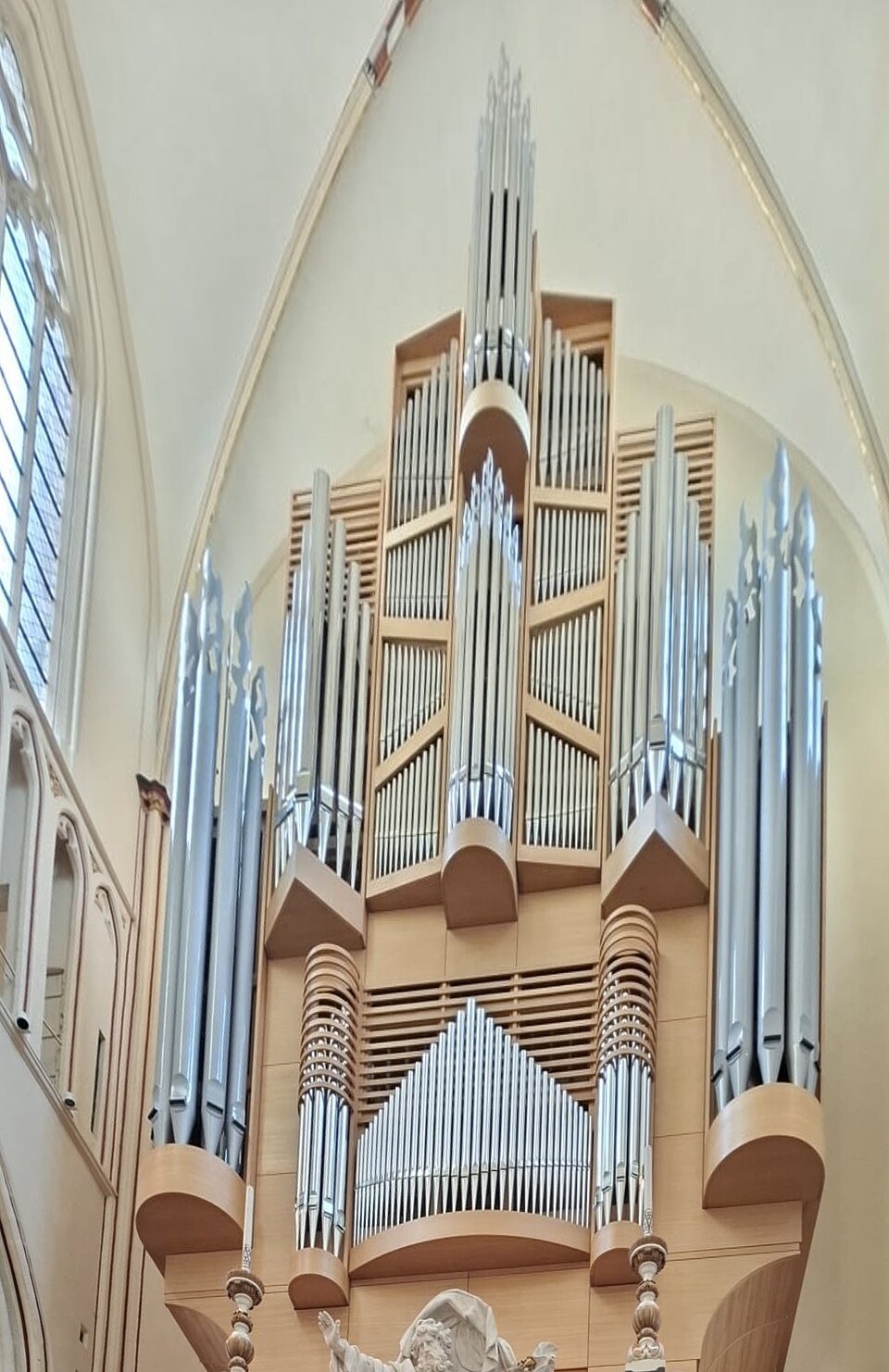
Inside, the nave rises in pale stone arches, and the first thing to notice is the carved rood screen, crowned by a statue of God the Father by Artus Quellinus the Younger. In 1935 the screen and the organ were moved towards the back of the church to open the view into the choir, so the long space reads clearly from end to end.
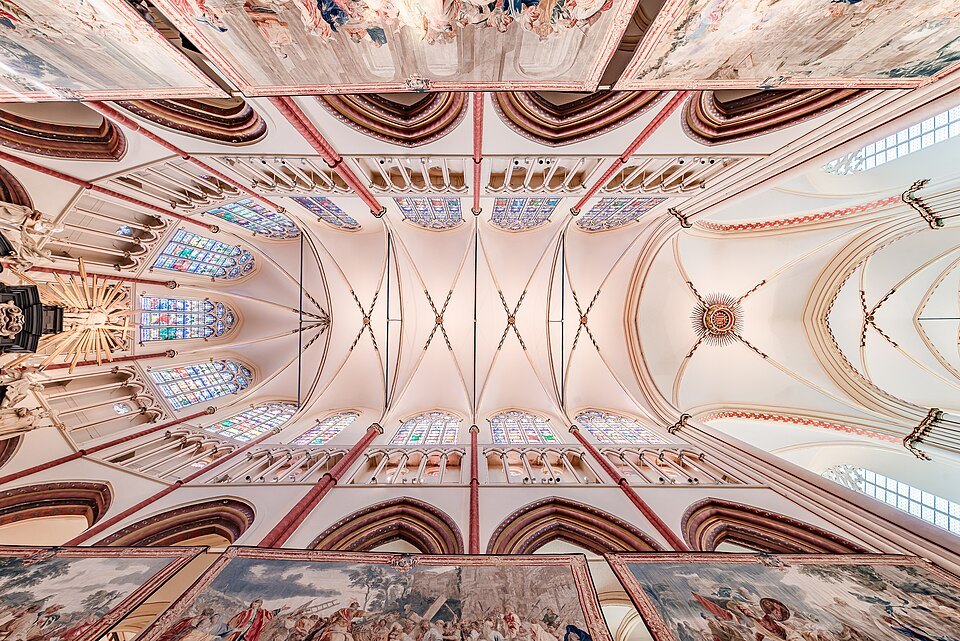
Along the walls hang eighteenth-century Brussels tapestries woven by Jasper van der Borcht in 1731 after paintings by Jan van Orley; the painted designs for them are kept in the treasury. Seventeen paintings by Jacob van Oost hang in the church, and above the choir stalls are coats of arms of the Order of the Golden Fleece from the chapter held here in 1478.
The treasury holds some of the finest painting in the city outside the museums, including work associated with Rogier van der Weyden, Dieric Bouts and Hugo van der Goes, the Hippolytus Triptych, and a Calvary from around 1520.
A long restoration
The cathedral has been cared for in stages. Exterior restoration began in 1976. Inside, work started in 2011, with the nave and side aisles finished by 2013 and the choir restored between 2014 and 2017, and the result is a bright, clean interior in which the colors of the paintings and tapestries show well.
Because it is a working cathedral, services take priority. Parts of the building may be closed during Mass and on feast days, and the treasury has its own arrangements.
How to visit
Allow half an hour for the church, and more if you also want to see the treasury. The cathedral is usually quieter than the other great churches in the center, even in summer, and it makes a good pause from the crowds of Steenstraat.
Dress as you would for any church and keep your voice low. Check the cathedral's own information before you go if you want to see the treasury.
St. Salvator's sits between the Markt and the Church of Our Lady: continue south down Heilige-Geeststraat and in five minutes you reach Our Lady, St. John's Hospital and the museums of the Dijver.
Nearby
- Along the DijverChurch of Our LadyThe church whose brick tower rises over the south of Bruges, holding a marble Madonna by Michelangelo and the tombs of…Read the page
- The two squaresThe MarktThe great open square at the center of Bruges, framed by gabled guild-style houses, the neo-Gothic Provincial Court and…Read the page
- Along the DijverSt. John's HospitalOne of the oldest surviving hospital buildings in Europe, where Augustinian sisters cared for the sick for eight…Read the page