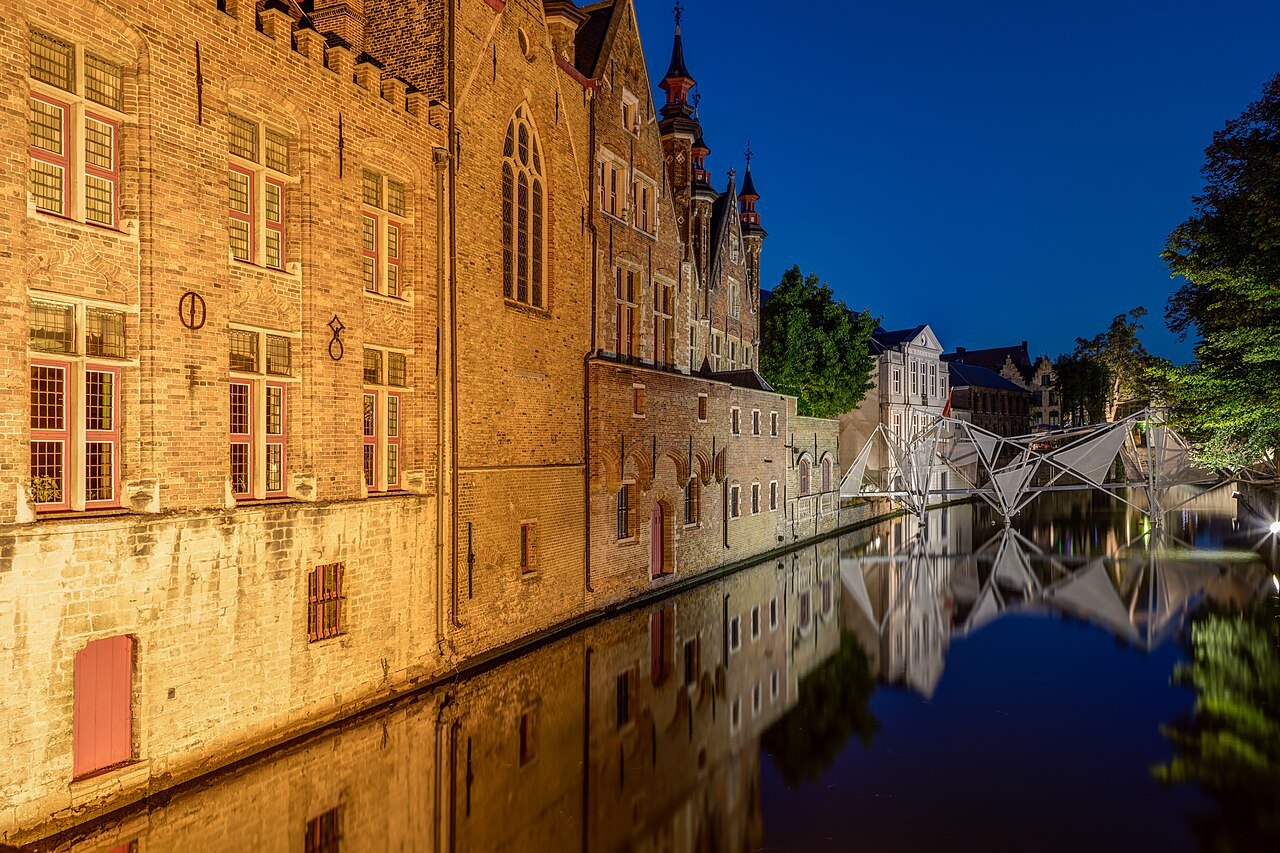
Why the Groenerei is the quiet canal
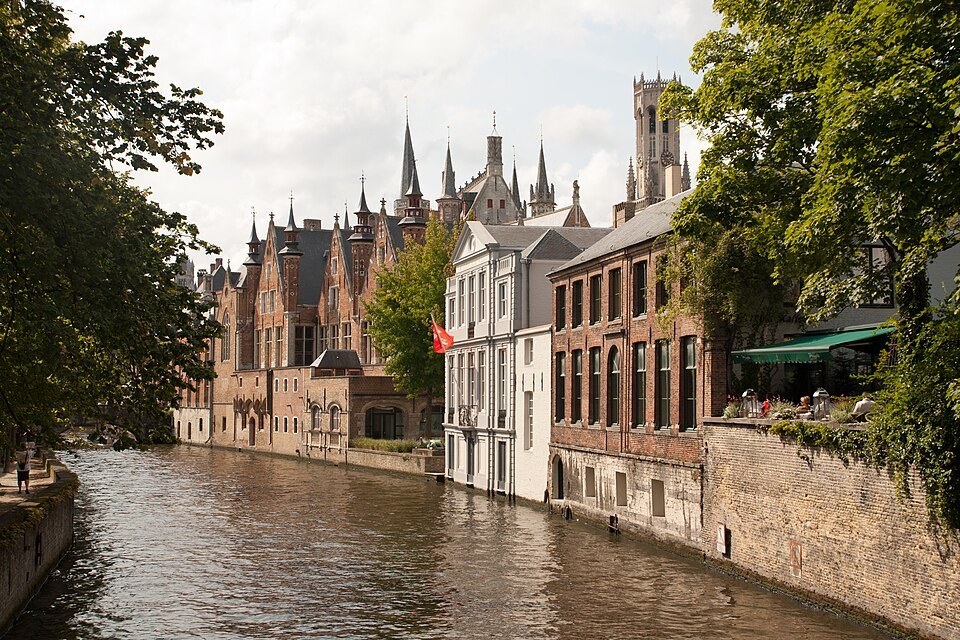
Step through the arch of the Blinde Ezelstraat from the Burg, cross the small bridge at its end, and turn left along the water. Within a hundred steps the crowds thin and the traffic disappears. The canal curves away under trees, past low almshouses and the tall brick back of an old government palace. This is the Groenerei, the green canal, and it is widely considered the most peaceful stretch of water in the center of Bruges.
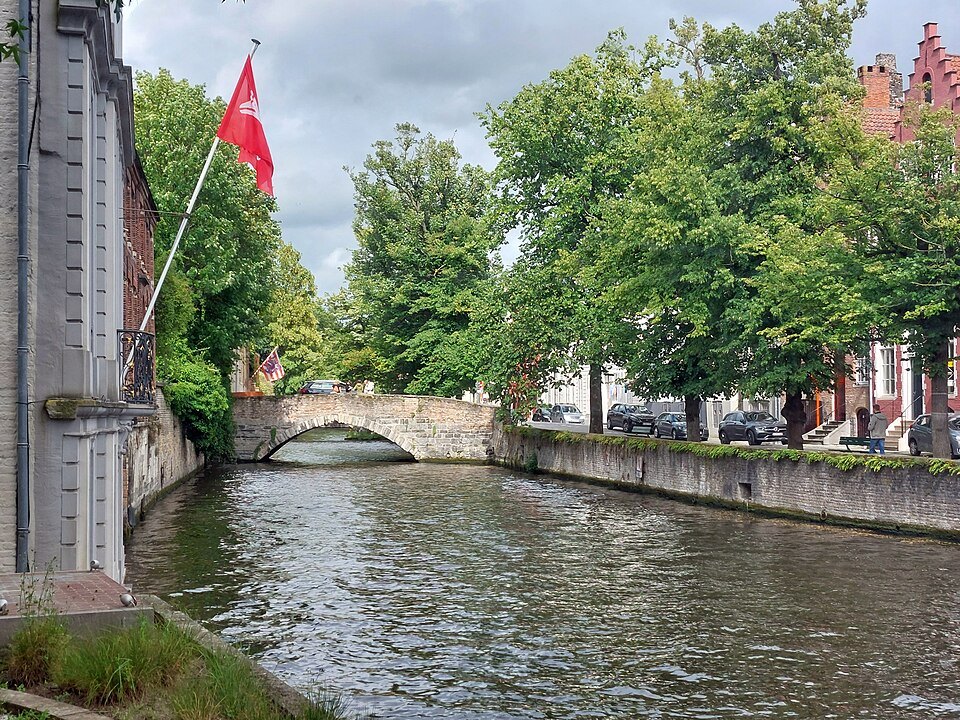
It is also where the canals feel most like part of daily life rather than a backdrop. The houses along it are homes, the quay is a street people cycle down on ordinary errands, and the boats that glide past are a small interruption rather than the main event. For a visitor coming straight from the ceremonial squares, the change in mood is immediate and worth noticing.
A canal with a long memory
The Groenerei is both a canal and the street that runs beside it. The water flows from the Kraanrei at the Huidenvettersplein to the point where it meets the Sint-Annarei and the Coupure near the Molenbrug. For centuries it was thought to have been dug by hand as a drainage channel for a distant mill; current understanding holds that it is instead a section of the natural course of the river Reie.
In 1127 this stretch became part of the first fortifications of Bruges, a detail that explains why the water still has the feel of a boundary rather than a backyard ditch. Until around 1825 the whole street was known as the Steenhouwersdijk. The later name Groenerei is thought to come from an old inn called 't Groene, a name long-time residents used informally for the street long before it became official.
What you actually pass
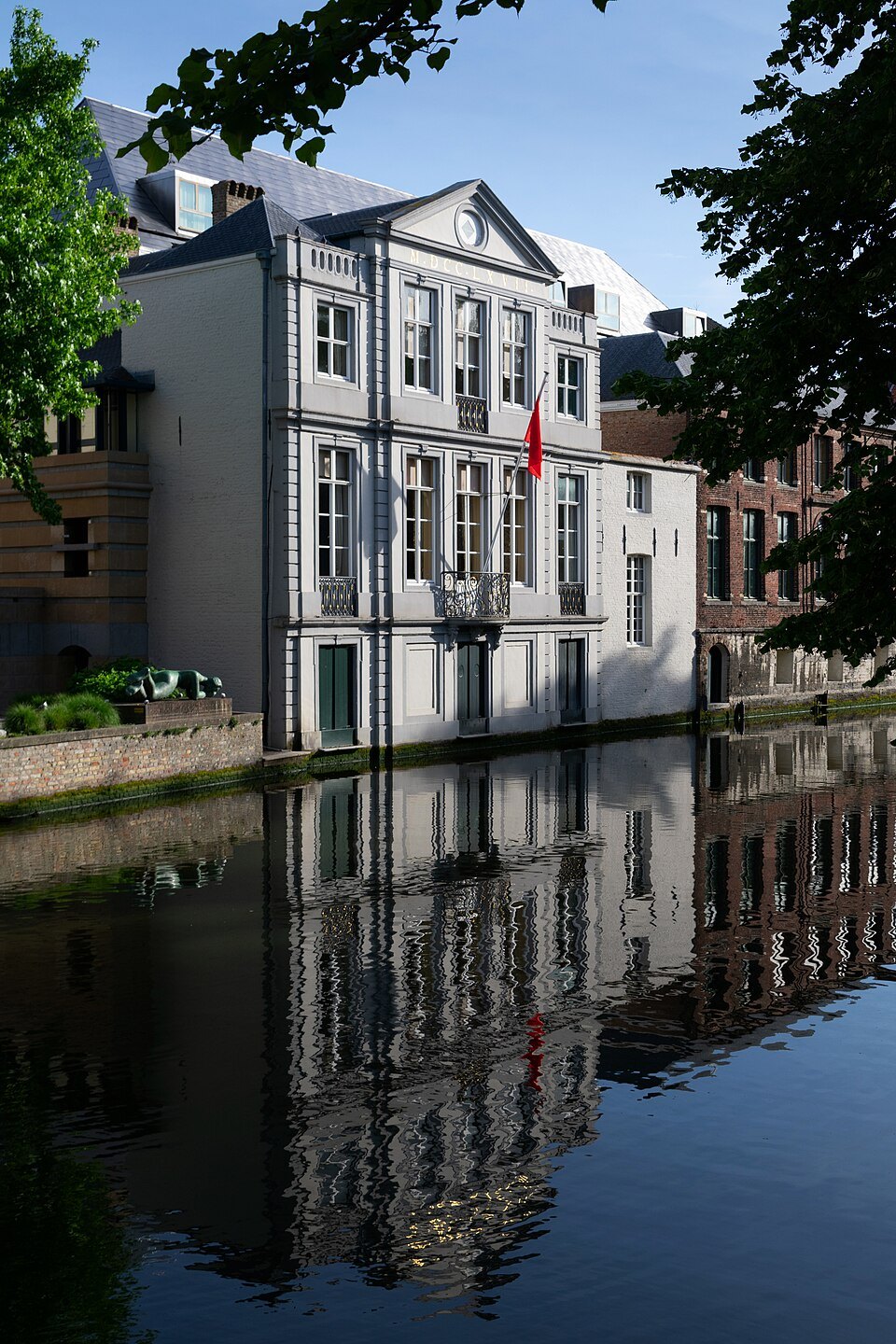
The quay begins at the Blinde Ezelbrug, one of three bridges over this stretch of water; the other two are the Meebrug and the Peerdenbrug. Across the water from the start of the walk rises the rear of the Landhuis of the Brugse Vrije, the Liberty of Bruges, its sixteenth-century fronts standing straight up out of the canal with none of the usual quay or railing between stone and water.
Further along stands the Godshuis De Pelikaan, a charitable almshouse named after the pelican, a medieval symbol of self-sacrifice. Keep going and the canal bends at the Peerdenbrug, where a look back along the water takes in the towers of the center. The street also carries a modest literary and political history: the Daveluy printing works operated here for decades in the nineteenth century, and the offices of a liberal newspaper, the Journal de Bruges, stood on the street afterward.
Almshouses and the texture of the quay
The almshouses along the Groenerei are a reminder of how the medieval and early modern city looked after its own. Low, whitewashed or brick, with a row of identical doors and a shared chapel or gateway, they gave elderly residents of modest means a small house to call their own. Bruges still has many such almshouses scattered through the old town, and this quay carries one of the gentler examples.
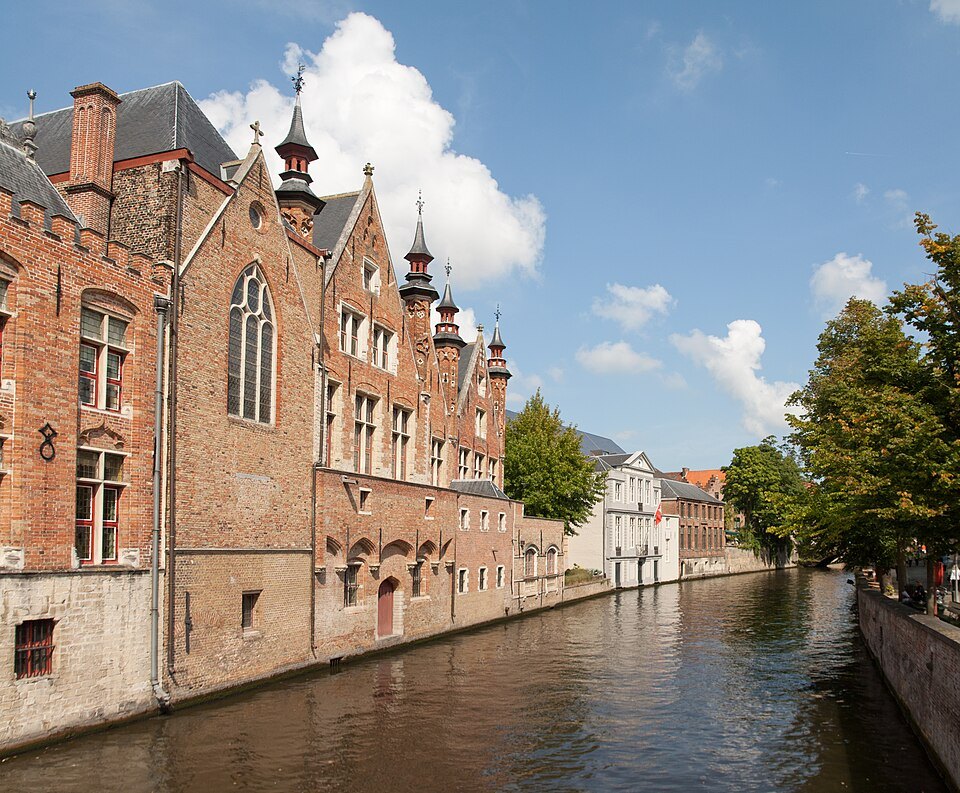
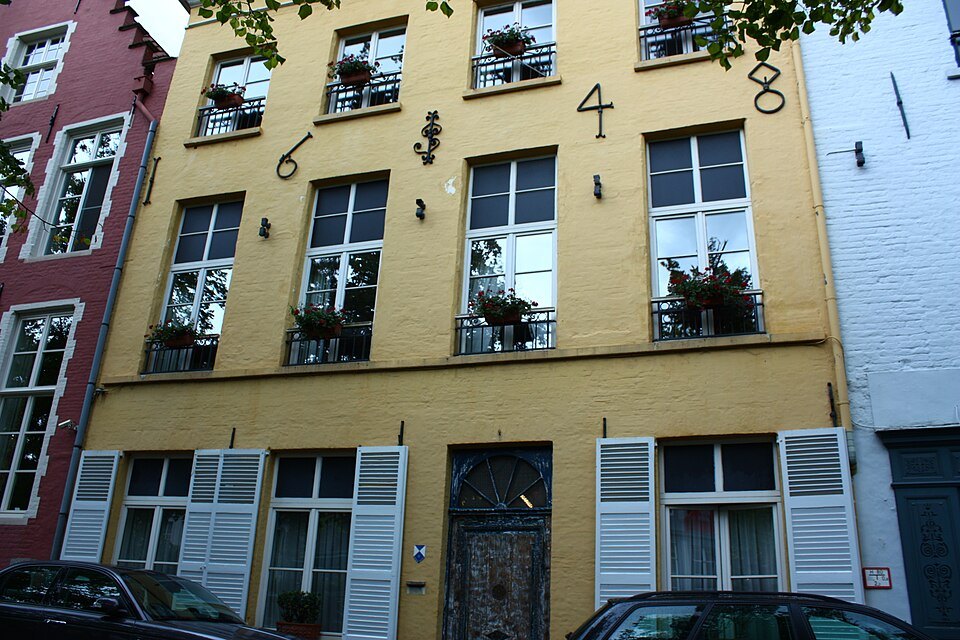
They still serve as homes today, and their calm fronts set the tone for the whole quay. Behind them and across the water, the houses are a mixture of centuries: stepped gables beside plain plastered fronts, garden walls with ivy, and back doors that open straight onto the canal rather than onto a street.
Few of these houses are grand, and that absence of grandeur is part of the appeal. The Groenerei shows the ordinary fabric of Bruges, the part of the city that lived and worked beside the water rather than the monuments built for display. The contrast with the squares just behind it is the real point of the walk, and it is worth pausing to feel it rather than rushing through.
The best views and when to take them
The two classic views of the Groenerei are taken from its bridges rather than from the quay itself. From the Meebrug, look along the canal with the trees overhanging the water and the houses doubled in reflection. From the Peerdenbrug, look back toward the center, where on a clear day the spires of the old town rise above the rooftops in a line that rewards a slow look rather than a quick photograph.
Early morning tends to give the stillest reflections, before the first boats ruffle the surface of the water. In autumn the trees along the quay turn color, and in winter the bare branches open up sightlines that are hidden in summer. On misty days the canal takes on the subdued look that led nineteenth-century writers to describe Bruges as a quiet, almost dead city, a mood this particular stretch of water still conjures easily.
How to visit well
The Groenerei is a public street, free to walk and open at all hours. Covering it from the Blinde Ezelbrug to the Peerdenbrug takes roughly ten minutes on foot, but it rewards a slower pace: stop on each bridge and let the canal set the rhythm rather than treating it as a corridor between sights. It stays quiet at most times of day, even in summer, because tour groups tend to cluster on the squares nearby.
Remember that people live along this quay. Keep to the paved walkway, avoid sitting on doorsteps, and do not photograph through windows or into private gardens. Give way to cyclists, who use the quay as an everyday route rather than a scenic one. The canal boats pass along this stretch too, so the same view can be seen from the water; for details of how that works, see the canal boats.
Where the walk leads
At its far end the Groenerei continues toward the Sint-Annarei and the quieter north-east corner of the old town, where the Jerusalem Church stands among streets with far fewer visitors than the center. Heading back the other way returns a visitor to the fish market, the Huidenvettersplein, and the Rozenhoedkaai, one of the most photographed corners of the canal network.
A loop from the Burg along the Groenerei and back by the Rozenhoedkaai makes an easy half hour built from the best canal scenery the center has to offer. It pairs naturally with a longer look at the Burg itself, or with a wider circuit of the canals for anyone with a full morning free and no fixed schedule to keep.
Read next
- The BurgWalking round the Burg, from the gilded Old Civil Registry to the lost cathedral under the hotelA walking guide to the Burg, from the gilded Old Civil Registry to the vanished cathedral beneath the hotel.Read
- RozenhoedkaaiPhotographing the Rozenhoedkaai before the crowds and after the lights come onHow to catch Bruges's most photographed canal corner in quiet morning light and again after dark.Read
- The Canal BoatsHow the canal boats work, from the landing stages to what happens when it rainsWhere to board, how tickets work, what the season and the weather change, and what the ride is actually like.Read