The view everyone comes for
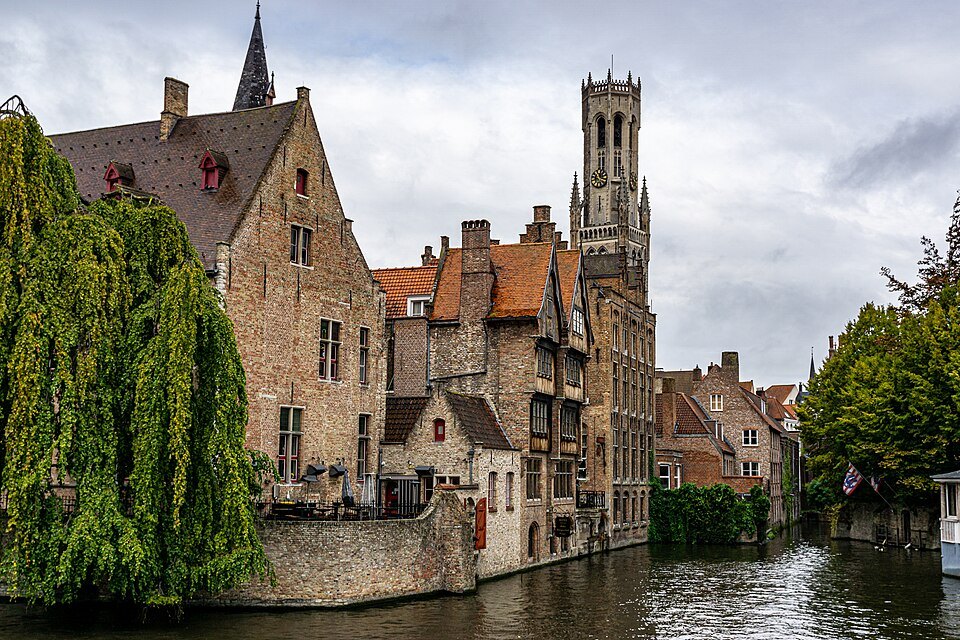
There is a moment, walking south from the Burg, when the street opens onto the water and the whole of Bruges seems arranged for a painting: a bend of dark canal, old brick houses standing straight up out of it, a willow, and above everything the tower of the Belfry. That is the Rozenhoedkaai. It is one of the most photographed places in the city, and it earns the attention it gets.
The quay itself is short, and there is not much to do here except look. That is the point. It is the best place in Bruges to understand how closely the town and its canals are woven together, and to see why the city is so often compared with Venice. Most people who come to Bruges for a single day end up here at some point, often without planning it.
Salt, rosaries and a novel
For centuries this was not a picturesque corner but a working wharf. The street was called the Zoutdijk, the salt dike, and a reference from the year thirteen ninety suggests that ships delivering salt were unloaded here. Salt was one of the essential goods of medieval trade, and Bruges was built on trade of every kind passing through its waterways.
The present name appeared in the eighteenth century. Stalls selling rosaries, rozenhoeden in old Dutch, were set up along the quay, and the name stuck ever since. A rosary quay suited a city whose churches and religious houses were everywhere, and whose trade in devotional objects was as steady as its trade in salt and cloth.
In eighteen ninety-two the Belgian writer Georges Rodenbach published Bruges-la-Morte, a novel about a widower wandering a silent, melancholy city, and he gave his main character a house on the Rozenhoedkaai. The book helped build the image of Bruges as a dreamlike place frozen in time, and that image still draws visitors, and photographers, to this exact quay.
What you actually see
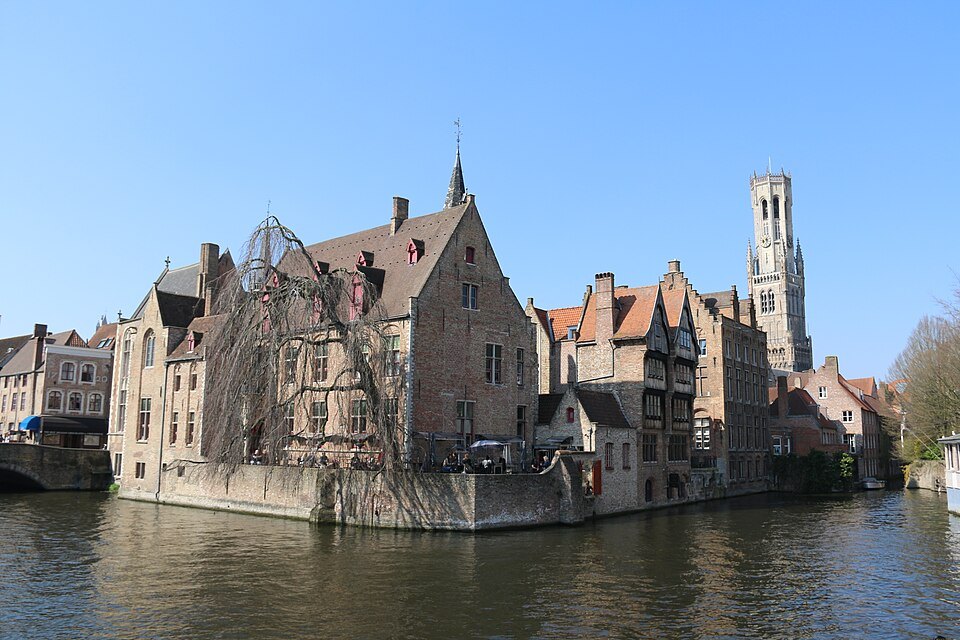
Stand at the quay wall and look along the water. On the far side the houses rise sheer from the canal, their brick fronts and stepped gables reflected in it, and behind them the Belfry fills the sky. To your right the canal bends out of sight; to your left it runs on towards the Dijver and the museums beyond it. A large building with a terrace directly on the water appears in almost every photograph taken from here.
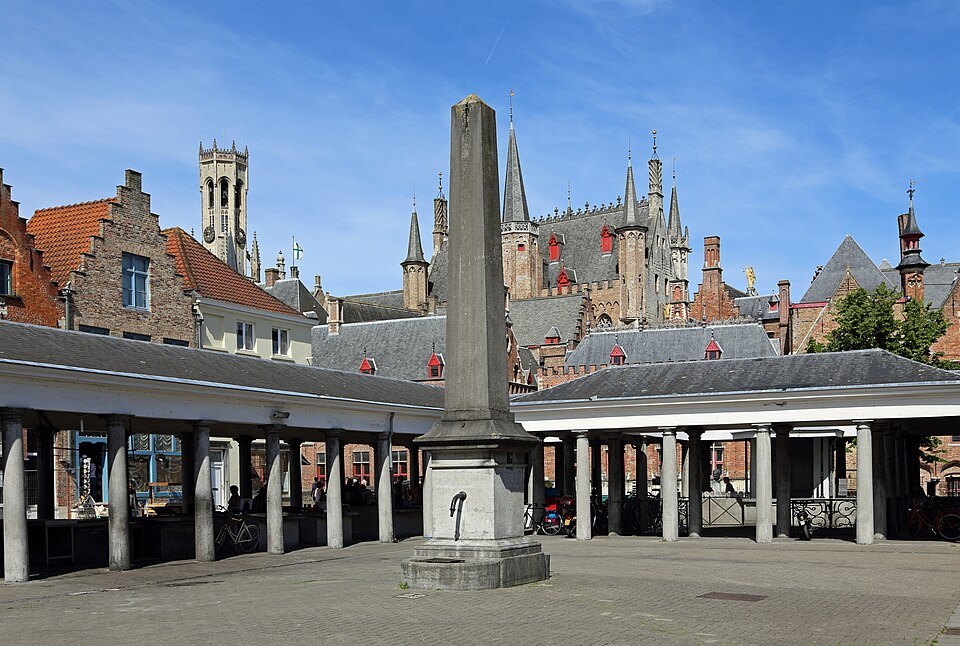
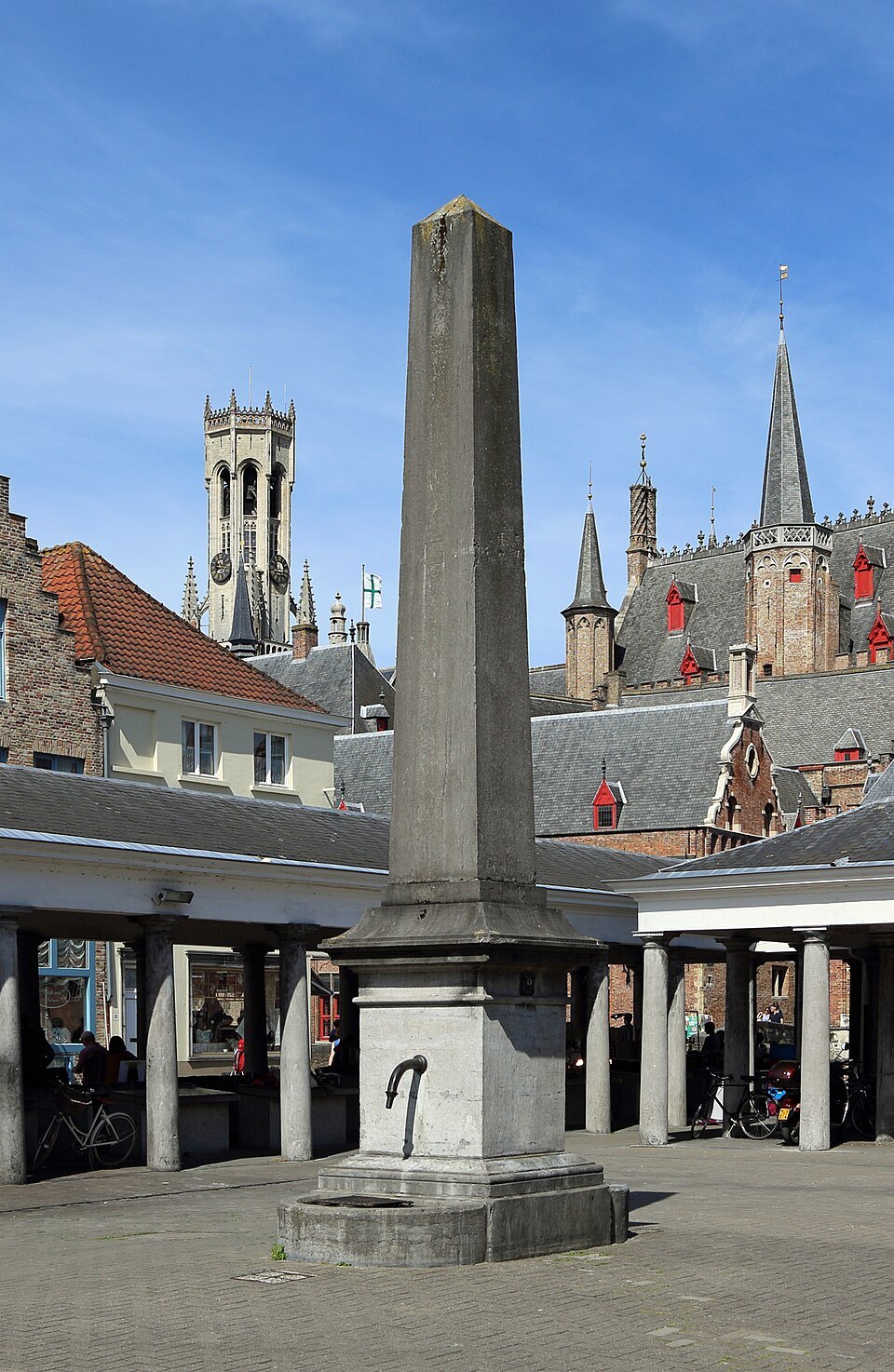
Close by is the Huidenvettersplein, a small square named after the tanners, with the tanners' old guild house on its corner and houses that face the canal behind it. It holds one of the city's boat landing stages, and it is worth the short detour even if boarding a boat is not the plan. A few steps further on is the fish market, the colonnaded market by Braambergstraat; the fish trade moved there, away from the Markt, in seventeen forty-five.
Along the quay itself the parapet is lined with flower boxes, and there is almost always a canal boat passing below, full of upturned faces. Look for the moment when a boat crosses the reflection of the Belfry; that is the photograph most people wait for, and it rewards patience more than any particular lens or camera setting.
Taking the photograph
The light is best in the morning, when the sun falls on the houses across the water and the quay is still quiet. By late morning in the warmer months the parapet is crowded, and visitors may have to wait a turn at the single best spot, which is well known and easy to find simply by watching where other cameras point.
Evening is also rewarding in a different way: the Belfry and the houses are lit, the boats have stopped running for the day, and the canal becomes very still. The reflections are sharper without the ripple of passing boats, and the quay empties out as the day's visitors move on to dinner elsewhere in the center.
A visitor does not need to stand exactly where everyone else does. Walking a few meters along the quay in each direction changes the angle on the tower and the bend of the canal considerably. Crossing to the Huidenvettersplein gives a lower view with the houses closer, and the bridges further along the Dijver give yet another angle on the same scene, often with far fewer people in the frame.
How to visit
The quay is a public street, open at all hours and free to stand on. Ten minutes is enough to see it properly; longer if the aim is to photograph it well, or simply to sit nearby and watch the boats go by. It is a natural stop between the Burg and the museums on the Dijver, and almost every walking route through the center passes it at some point.
The boats that leave from here and from the Huidenvettersplein are the easiest way to see the canals from the water, and the canal boats page explains how booking and boarding works. A trip takes about half an hour, and the boats have no roof, so an umbrella is handed out if rain starts partway through. Checking the current arrangements with the boat operator at the landing stage is sensible before joining a queue.
The steps down to the landing stages are steep and there is no lift, so the boats are not a realistic option for visitors using a wheelchair or with limited mobility. The quay itself is level and easy to reach from any direction, and the view from the parapet costs nothing and needs no planning at all, which makes it one of the few well-known sights in Bruges that never requires booking ahead, unlike the Belfry climb.
Where to go next
Follow the water south and the quay becomes the Dijver, with the Groeningemuseum and the tree-lined canal and, beyond it, the Gruuthuse and the Church of Our Lady. This stretch rewards a slow walk rather than a rushed one, since the water and the buildings keep changing angle with every few steps.
Walking back north through the fish market and the Blinde Ezelstraat arch leads to the Burg, with its own cluster of historic buildings and the chapel holding the relic of the Holy Blood. Turning instead along the Groenerei gives the quietest stretch of canal in the center, with far fewer visitors and a similar reflection of brick and water.
Either direction makes sense as a next stop, and neither requires much planning. The Rozenhoedkaai works well as a hinge point in a day's walk: arrive early for the photograph, pass through again in the evening for the lit version, and let the rest of the route unfold from whichever direction looks least crowded at the time.
Read next
- ItinerariesSeeing Bruges in a single day without spending it in queuesA walking plan for one day in Bruges that puts the famous squares early and late, the museums in the middle, and keeps lines and crowds to a minimum.Read
- The BurgWalking round the Burg, from the gilded Old Civil Registry to the lost cathedral under the hotelA walking guide to the Burg, from the gilded Old Civil Registry to the vanished cathedral beneath the hotel.Read
- The BelfryThe Belfry climb is worth booking, and here is how to time it with the bellsWhat climbing the Belfry of Bruges involves, why a time slot matters, how to be near the carillon when it plays, and who should skip the stairs.Read