Why make this walk
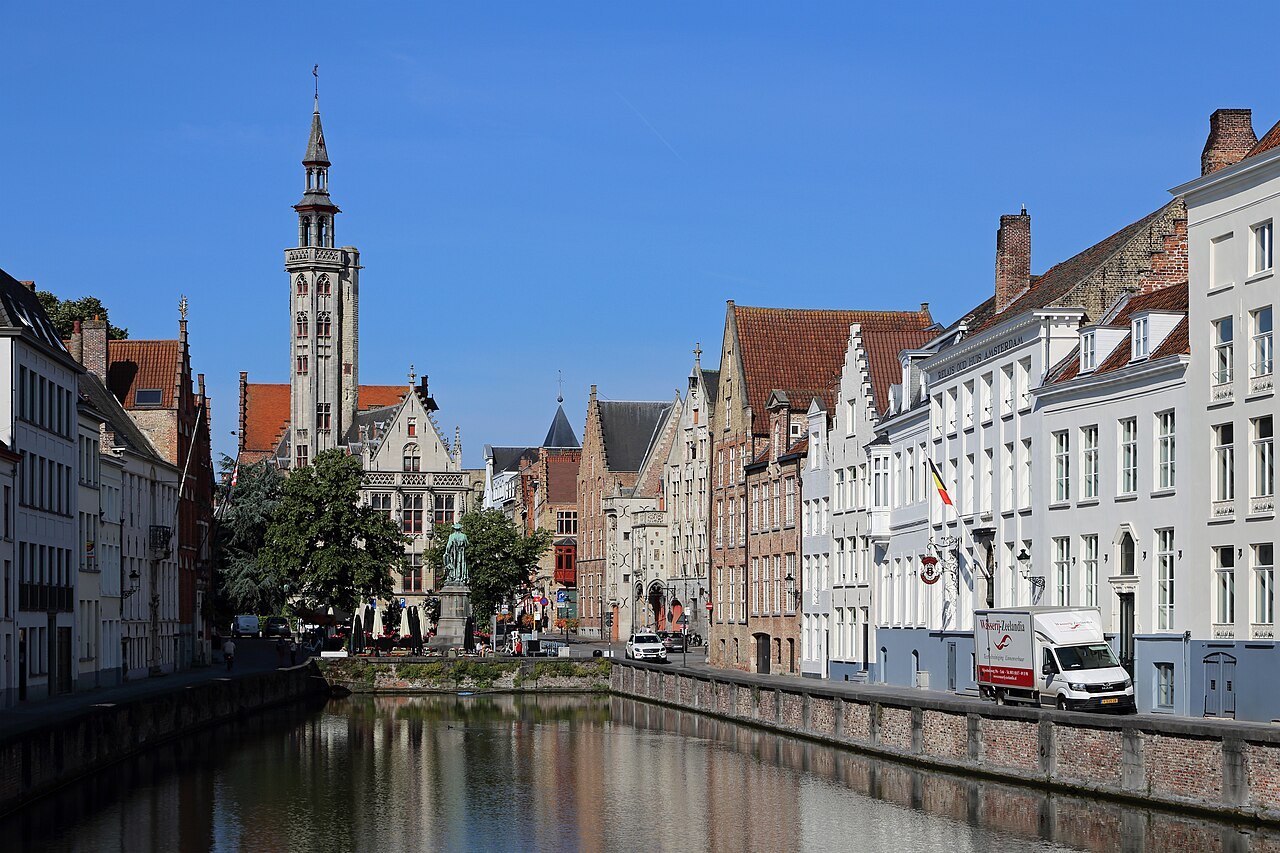
Five minutes north of the Markt, the crowds thin out and the streets open onto a small square at the end of a canal. Brick and white houses line the water, a slender tower rises on one corner, and a painter in stone looks out over it all. This is Jan van Eyckplein, once the business district of medieval Bruges, where ships unloaded and merchants from across Europe met.
Walking there from the Markt takes a matter of minutes along Academiestraat and Vlamingstraat, but the change of mood is immediate. Where the Markt is given over to cafés, horse-drawn carriages, and the belfry crowds, this quarter is residential and quiet. For anyone trying to picture Bruges as a working port rather than a museum town, the square and the canal beside it, the Spiegelrei, give the clearest sense of it in the whole city.
The square and its names
The square looks older than it is. It was laid out shortly after 1787, when a bridge called the Sint-Jansbrug was demolished and part of the Kraanrei canal was vaulted over to make open ground. Before that the water ran straight through, and the harbor trade it carried had already been the reason for the district's existence for centuries.
Its name has shifted with the city's politics and habits. It was first called after the demolished bridge, then, during the French period, the Academieplaetse, because an art academy was housed on the square. In 1844 the city renamed it for Jan van Eyck. For most of its history before the twentieth century, though, people simply called it the Petattenmarkt, after the weekly potato market held there.
Jan van Eyck in stone
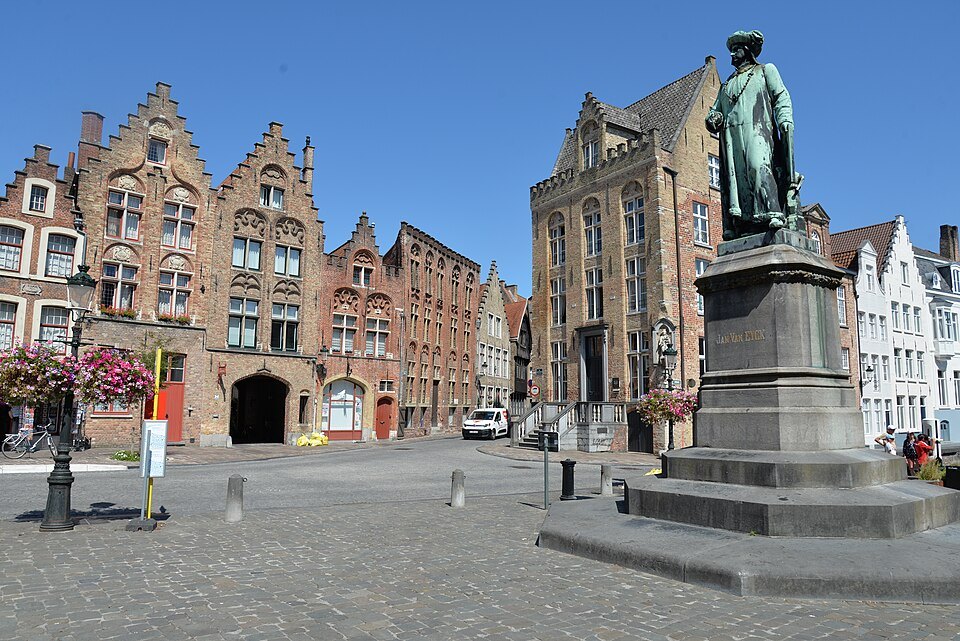
Jan van Eyck moved to Bruges around 1425 in the service of Philip the Good, Duke of Burgundy. He bought a house in the city in 1432 and died there on 9 July 1441. He remains the most famous painter ever to work in Bruges, and two of his masterpieces hang in the Groeningemuseum, a short walk south; the Flemish masters page tracks his work and that of his successors across the city.
The statue on the square today is not the first. A marble figure by Jan-Robert Calloigne went up in 1856 and was removed in 1871. The present monument, on a tall bluestone pedestal, dates from 1878 and was designed by Hendrik Pickery. Its arrival had an unexpected side effect: it prompted the restoration of the surrounding houses, which is one reason the square now reads as a complete, harmonious whole.
The Poortersloge and its bear
On the west side of the square stands the Poortersloge, the burghers' lodge, built between about 1395 and 1417 as a meeting place for the commercial elite of the city. Its tall, narrow tower is the landmark of the whole quarter and can be picked out from far along the canal, a useful point of reference when exploring the surrounding streets.
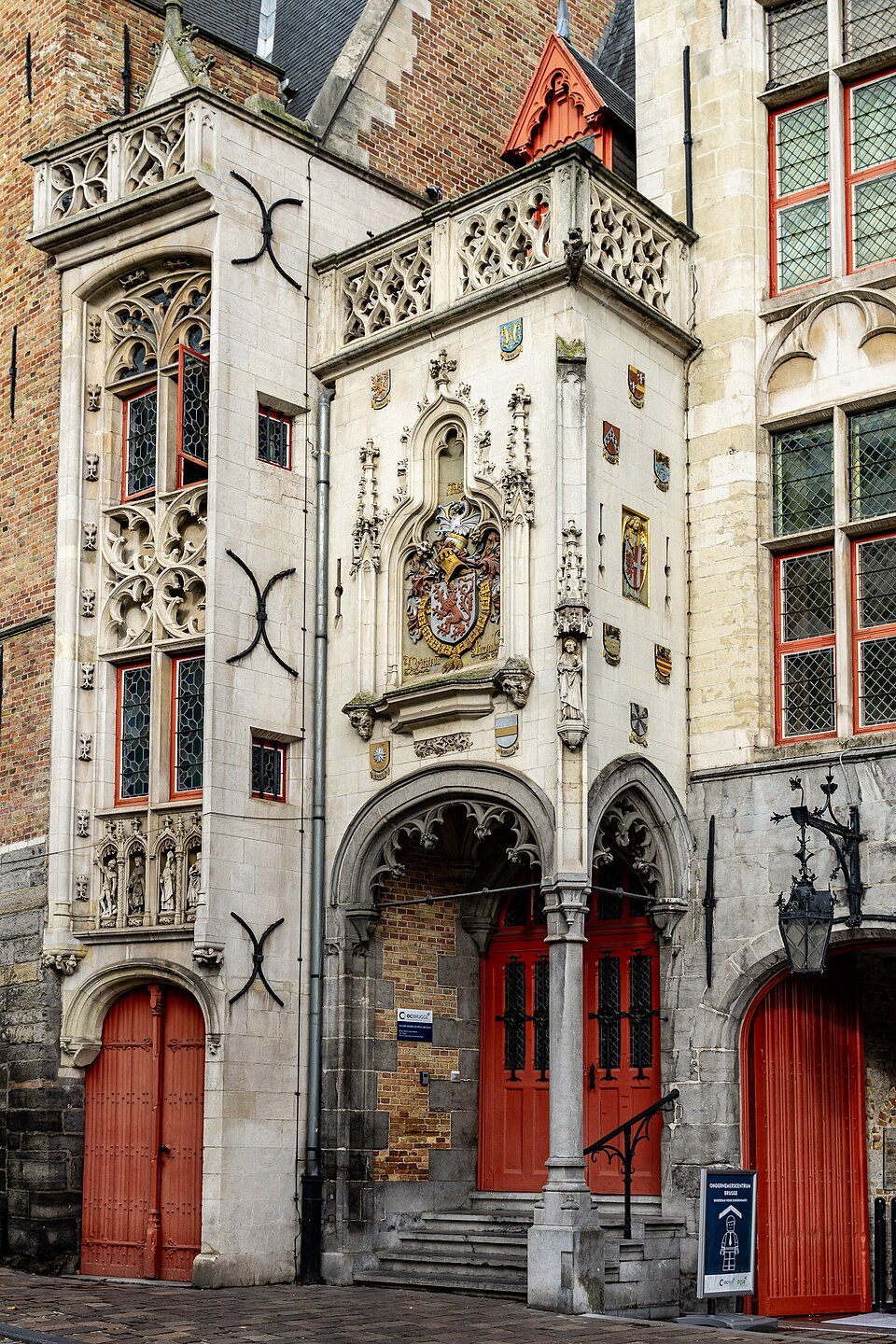
The lodge was probably built, and was certainly owned, by the Society of the White Bear, a jousting club founded around 1380. Its mascot, a small bear holding a shield, sits in a niche on the corner of the building; locals call it the Beertje van de Loge, the little bear of the lodge. It is easy to miss walking past quickly, so pause at the corner before moving on.
The building has carried many functions since. A fencing guild practiced there in the sixteenth century; the city's Free Academy of Arts occupied it from 1720 to 1890, and the State Archives from 1912 to 2012. A fire in 1755 forced heavy rebuilding, and a nineteenth-century extension was removed again in 1897 by the architect Louis Delacenserie to bring back its late Gothic character. Since 2016 the lodge has been used for exhibitions of contemporary art, each with its own arrangements to check with the organizers.
What the square actually shows
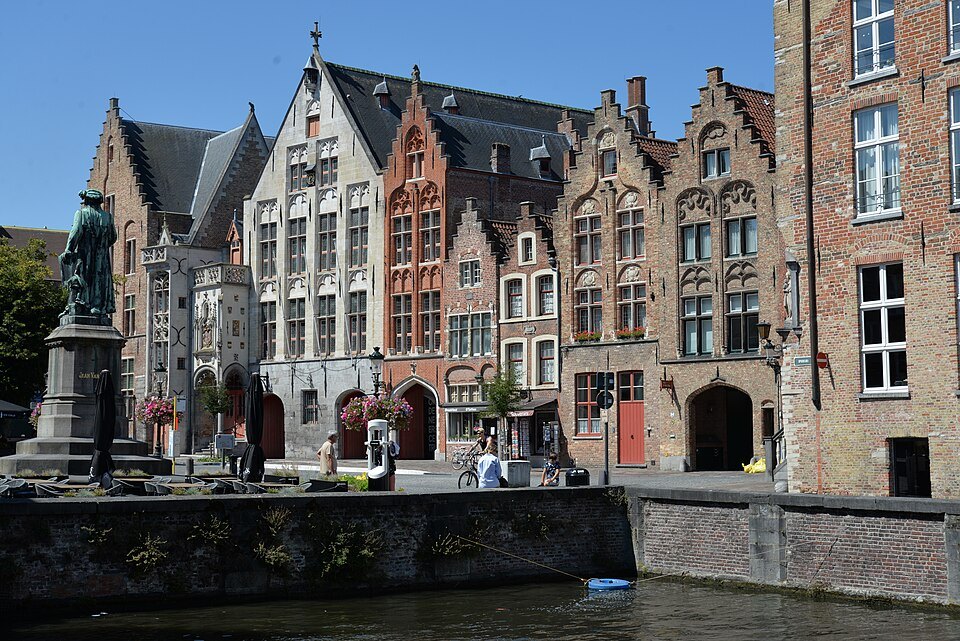
Stand by the statue and turn slowly to take in the whole quarter. To the west is the Poortersloge with its tower and bear. On the north side sit the old toll house and a row of merchants' houses, their broad doorways built to take goods directly in and out from barges on the water, rather than to welcome casual foot traffic.
To the east the Spiegelrei runs off between rows of gabled fronts, reflected in water that is usually quite still, with the lodge's tower doubled in the surface. The names around the square still carry the memory of the trading nations that worked here, including the Biskajersplein just to the south, named for merchants from Biscay. The Hanseatic League also kept an office in this district when Bruges was at its height.
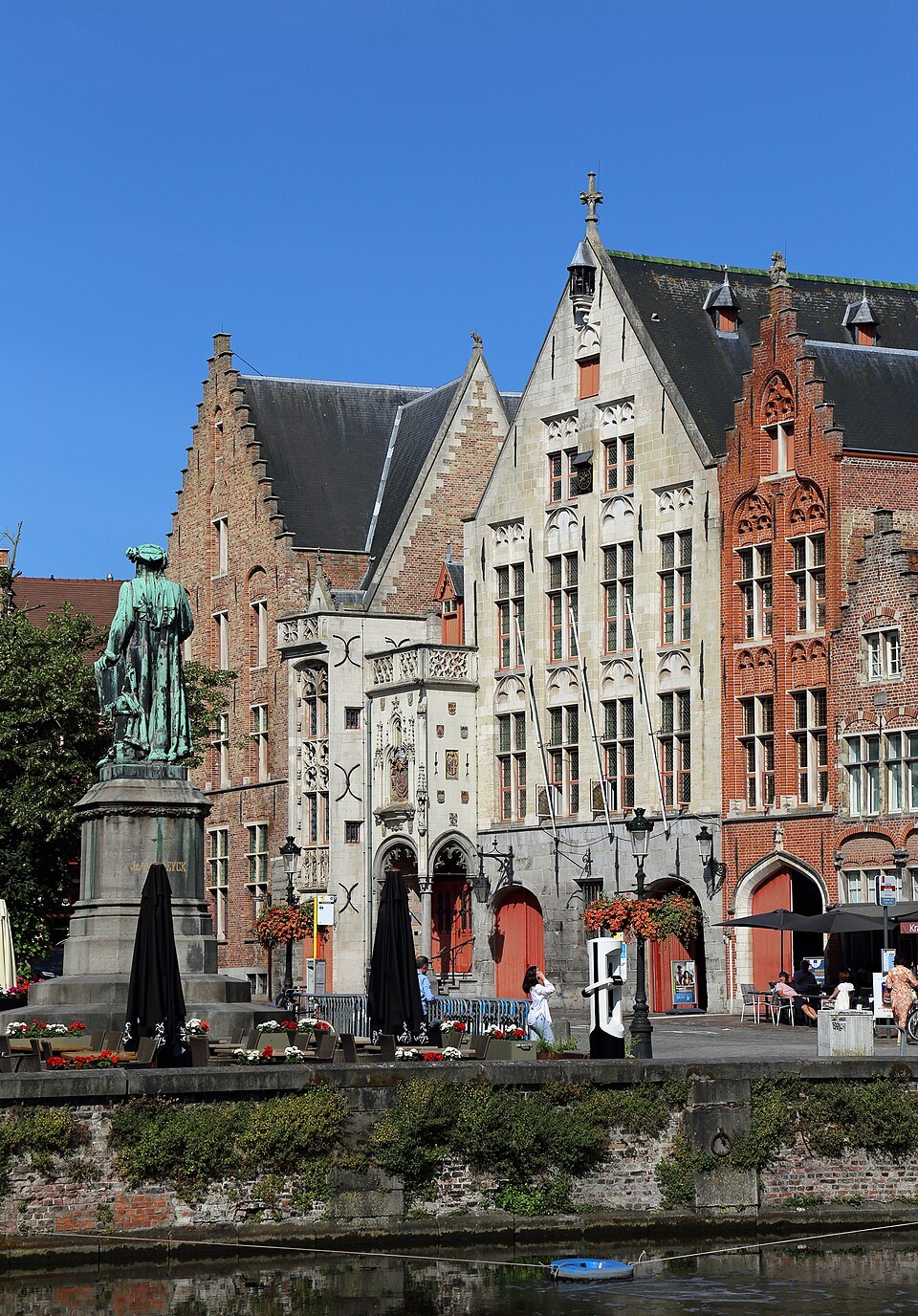
A short stretch of walking along the Spiegelrei and a look back toward the square gives one of the better views of the whole group of buildings together. Crossing the Koningsbrug offers a different angle, straight down the canal. The quays here are lined with some of the most varied house fronts in Bruges, from medieval brick to later white-plastered facades, and the quarter rewards unhurried looking more than quick photographs.
Planning the visit
The square itself is public and always accessible, and fifteen minutes is enough to see it properly; allow longer if the plan includes a walk along the Spiegelrei as well. Exhibitions inside the Poortersloge run on their own schedule, so anyone wanting to see what is on display should check directly with the venue before setting out, rather than assuming access on the day.
Morning light suits the square particularly well, reaching the house fronts along the canal and giving the water its clearest reflections. Through the rest of the day the quarter stays quiet by comparison with the Markt, which makes it a good stop for anyone wanting a break from busier streets without leaving the historic center.
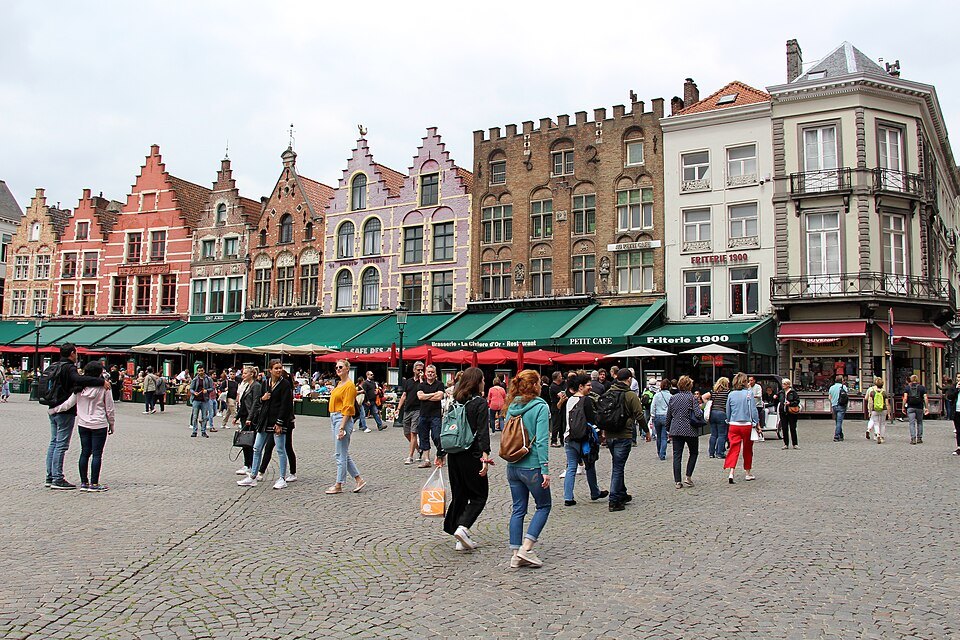
Canal boats turn near this stretch of water, so expect to see them pass even without boarding one; details on routes and landing points are on the canal boats page. From the square, walking east along the Spiegelrei and the Langerei leads into the quieter northern canals, covered on the canals page, while Academiestraat and Vlamingstraat lead back south to the Markt and, beyond it, the Burg, about ten minutes away on foot.
Read next
- The Flemish MastersWhere to see Van Eyck and Memling in Bruges in one unhurried dayA route through the Groeningemuseum, the Church of Our Lady and St. John's Hospital to see the paintings made in fifteenth-century Bruges, and what to look for.Read
- The Canal BoatsHow the canal boats work, from the landing stages to what happens when it rainsWhere to board, how tickets work, what the season and the weather change, and what the ride is actually like.Read
- The BurgWalking round the Burg, from the gilded Old Civil Registry to the lost cathedral under the hotelA walking guide to the Burg, from the gilded Old Civil Registry to the vanished cathedral beneath the hotel.Read