The city's living room
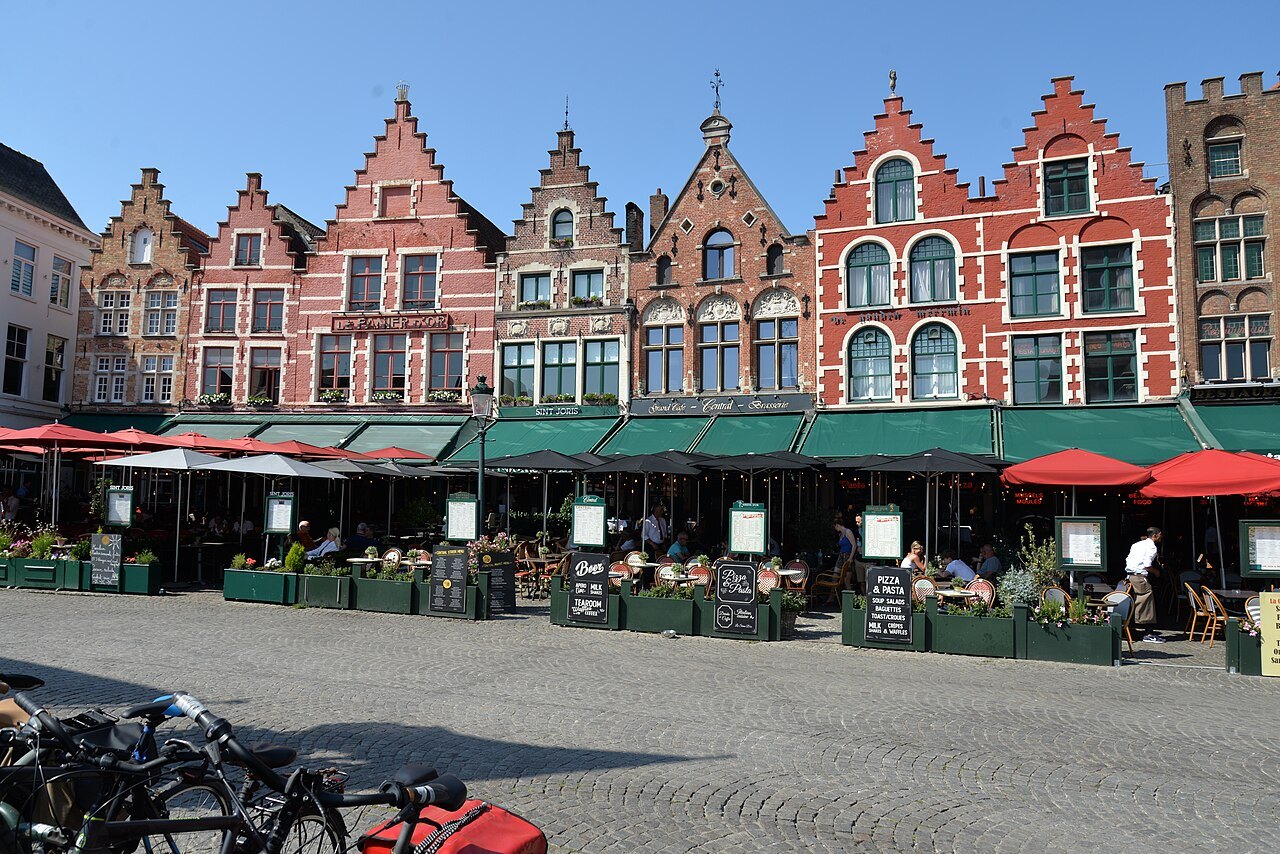
The Markt is where almost every visit to Bruges begins. Streets from the station, the Burg and the shopping streets all run into it, and the square is large enough, about a hectare, to absorb the crowds without ever feeling small or hemmed in. On its south side the Belfry rises over the old market halls; on the other three sides stand rows of tall houses and the elaborate Provincial Court, each front telling a slightly different part of the story.
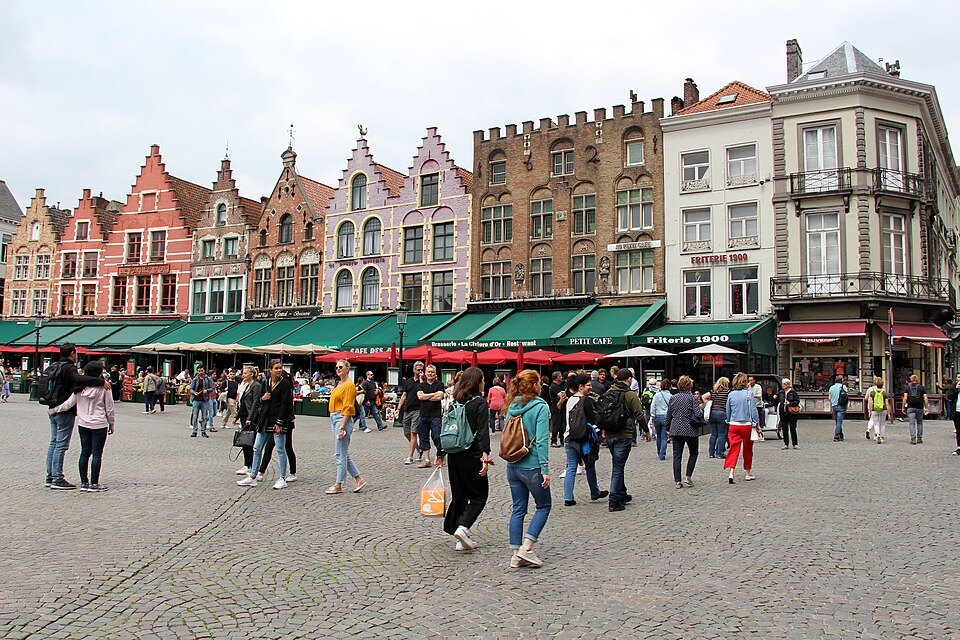
People have gathered on this square since the tenth century. It was the commercial heart of Bruges when the city was one of the great trading towns of northern Europe, and it remains where the town meets today: for markets, for events, and simply to sit on a terrace and look up at the gables. Almost any walk through the center passes through it at least once, often several times in a single day.
A thousand years of trade
Around the year 1200 Bruges held its first international annual fair, and around 1220 the first hall was built on the square as a place to sell merchants' goods. A larger wooden hall with a tower followed around 1240; after a fire in 1280 it was rebuilt in stone between 1291 and 1296. That stone building is the ancestor of the halls still standing at the foot of the Belfry today, and the reason the square has always organized itself around that corner.
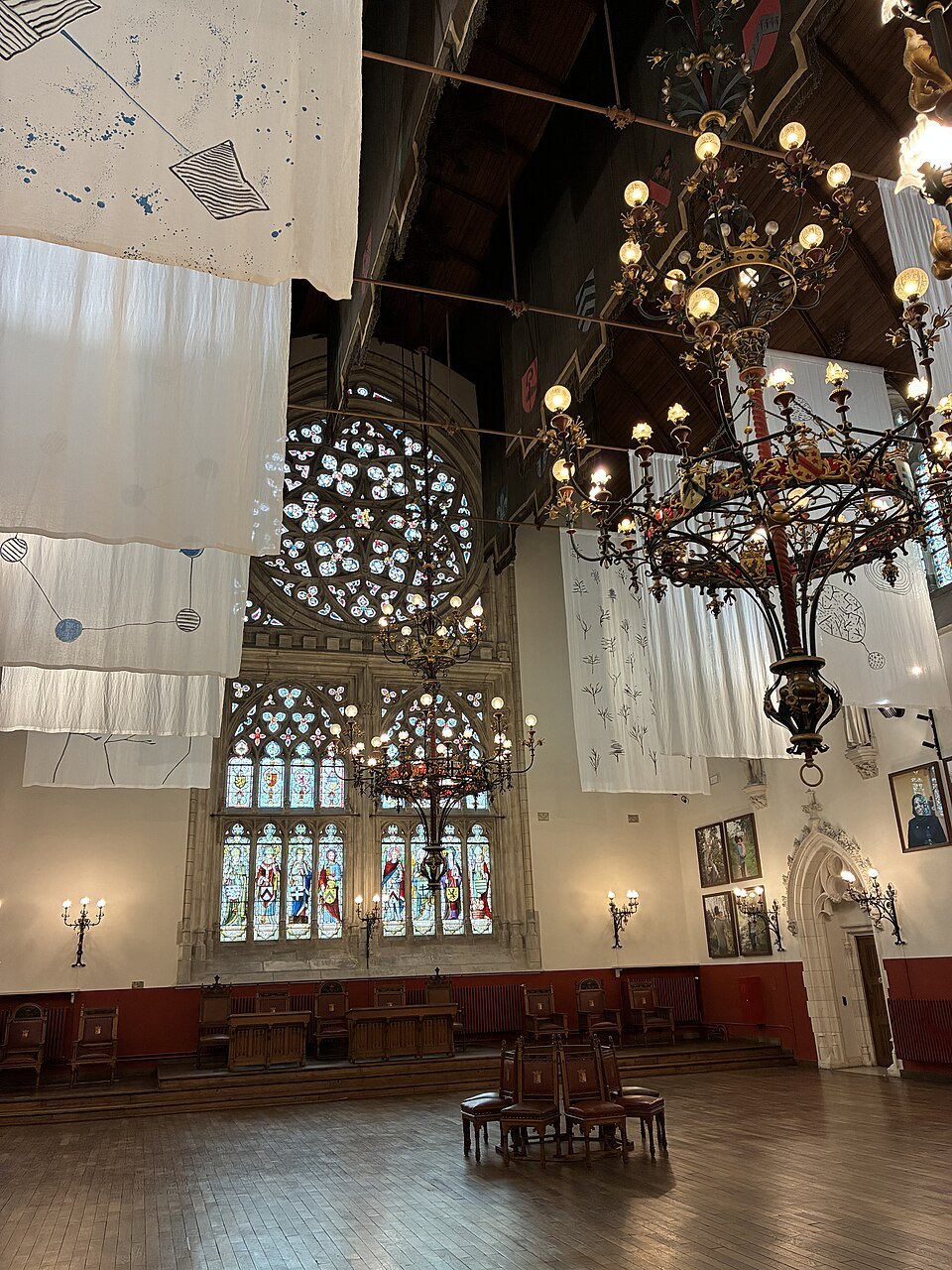
The east side of the square was once dominated by the Waterhalle, a covered hall where boats could unload goods under cover, right in the middle of the city. It was demolished in 1787 and replaced by a classicist building, which went on to serve as the provincial court from 1850. A fire in 1878 destroyed that building in turn, and it was rebuilt in the neo-Gothic style visible today, finished in 1887, with pinnacles and arcades that now look older than they are.
Fish was sold on the Markt from 1396 onward, and in 1709 an iron fish market was put up on the square itself; the trade later moved to its own market by the canal in 1745. For a short spell under French rule, between 1807 and 1810, the square was even renamed Place Napoléon, a detail that has left no visible trace beyond the history books.
The statue of Breydel and De Coninck
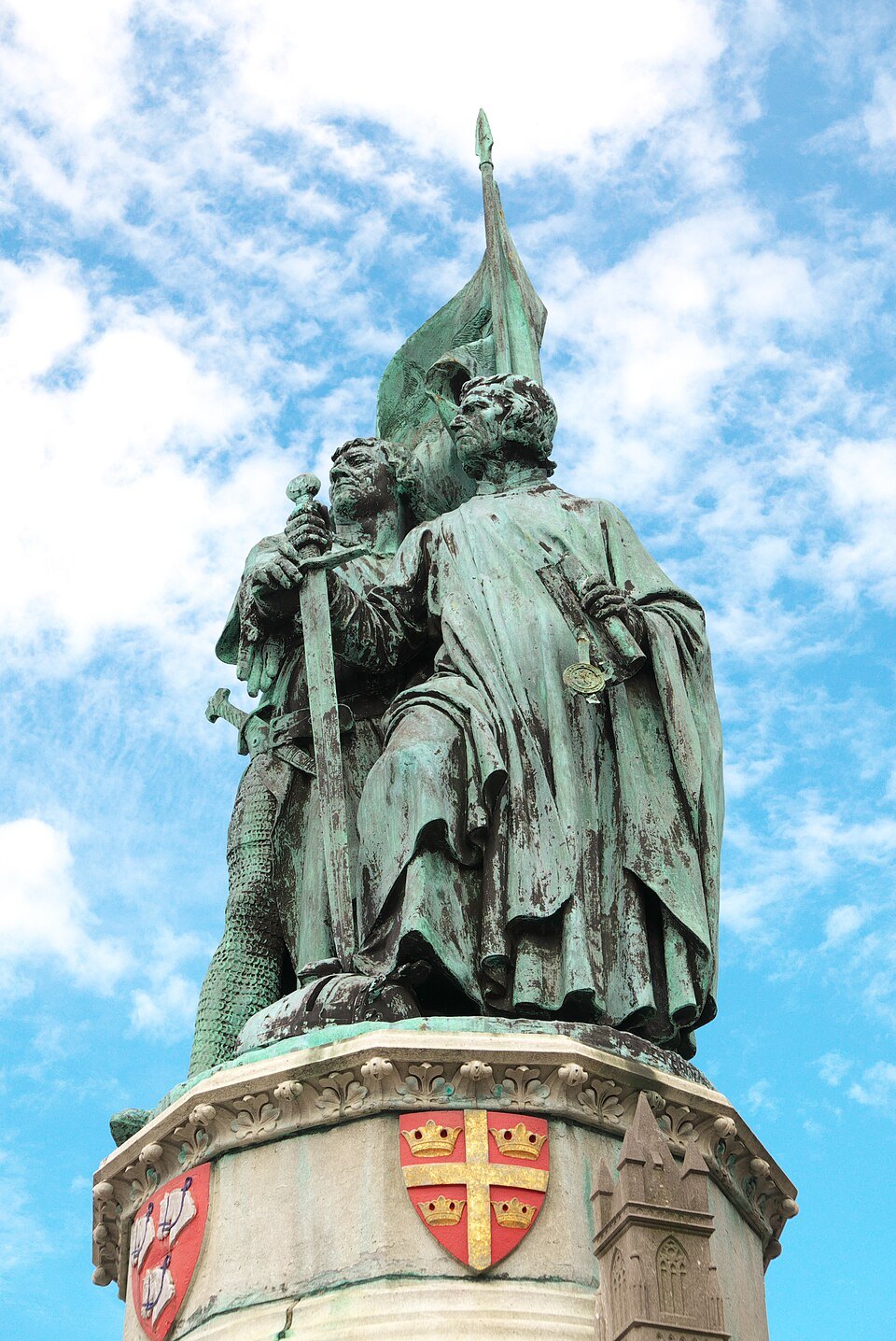
In the middle of the square stands a bronze pair of figures: Jan Breydel and Pieter de Coninck, leaders of the Bruges rising against French rule in 1302 that ended in the Battle of the Golden Spurs. The statue was unveiled in July 1887 and formally opened by King Leopold the Second the following month, at a moment when Belgium was keen to celebrate its own medieval heroes.
The two men are presented as champions of Flemish independence, and the monument says as much about the nineteenth century that raised it as it does about the fourteenth century it depicts. It works well as a meeting point precisely because it sits at the center of the square, and from its base a visitor can take in all four sides at once, which is a useful way to get oriented before setting off in any direction.
What you actually see
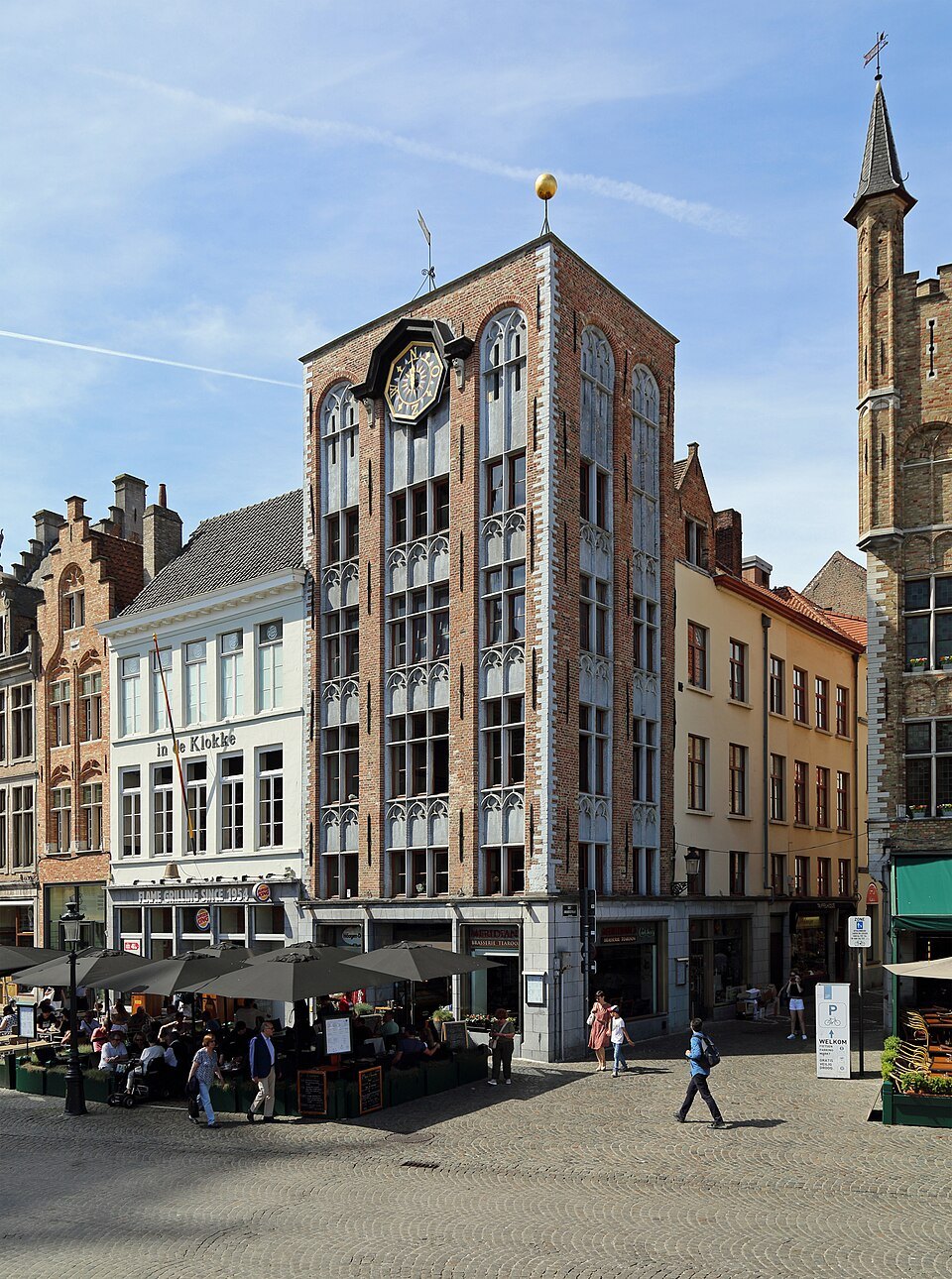
Start with the north side, the row of houses that turns up on most postcards: tall stepped and bell-shaped gables in red and cream brick, with café terraces and awnings running along the ground floor. Together they give the square the silhouette most people picture when they think of Bruges, and it is worth walking the length of the row rather than photographing it from one spot.
At the corner of Sint-Amandsstraat stands Huis Craenenburg. In 1488 the citizens of Bruges held Archduke Maximilian, heir to the Habsburg lands, prisoner inside this house, an episode that still shapes how the building is described to visitors. On the east side the Provincial Court, with its pinnacles and arcades, shares the frontage with the old post office building, and the two make an interesting contrast with the domestic gables opposite.
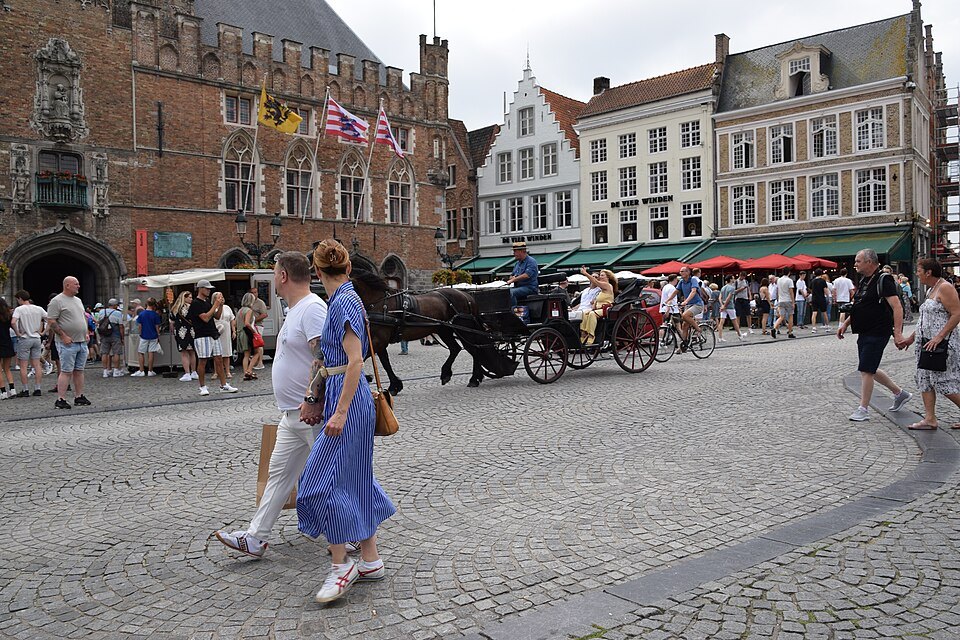
The paving itself is part of the story too. Until a renovation carried out in 1995 and 1996 the Markt was, remarkably, used as a car park. That work removed the parking and made the square mostly traffic-free, and it reopened in 1996 in something close to its current form. Horse-drawn carriages still wait on the square for passengers, and their clatter over the stones is one of its most familiar sounds, day and evening alike.
How to visit
The Markt costs nothing to see and is always accessible. Reading it properly takes as long as a visitor wants to give it: about twenty minutes is enough to walk round and take in the fronts, longer if the plan includes a terrace and a slower look at the detail on the gables. The square is busiest from late morning to late afternoon in the warmer months, when tour groups pass through on the way between the Belfry and the Burg.
For photographs, early morning tends to work best, before the terraces fill and while the light falls across the north side. The square is also worth a second visit after dark, when the Belfry and the gables are lit and the crowds have thinned considerably.
For a view straight down onto the square, book a slot for the Belfry climb; the view from the tower over the Markt and its rooftops is one of the best in the city, though the climb itself takes some planning ahead, covered separately under booking ahead. The square also hosts markets, a Christmas market and other events through the year, so its appearance changes with the season; see when to come for a sense of what to expect at different times.
Where to go next
The Markt is the hub from which the rest of the center is walked, and almost every itinerary in Bruges treats it as a starting point rather than a destination in itself. The Burg and the Basilica of the Holy Blood are two minutes east along Breidelstraat; the canals and the Rozenhoedkaai are five minutes south-east; and the merchants' quarter around Jan van Eyckplein lies a short walk north along Vlamingstraat.
Because every route through the city crosses it at some point, the Markt also works as a reliable reference point for finding the way back. If a visitor loses their bearings in the smaller lanes, the simplest fix is to look for the Belfry above the rooftops and walk toward it; within a few minutes that will lead back onto the square, and from there the rest of the center is easy to find again.
Read next
- ItinerariesSeeing Bruges in a single day without spending it in queuesA walking plan for one day in Bruges that puts the famous squares early and late, the museums in the middle, and keeps lines and crowds to a minimum.Read
- The BelfryThe Belfry climb is worth booking, and here is how to time it with the bellsWhat climbing the Belfry of Bruges involves, why a time slot matters, how to be near the carillon when it plays, and who should skip the stairs.Read
- Getting HereDriving to Bruges means parking at the edge and walking inWhy Bruges discourages cars in its old town, which car parks and park-and-ride sites to use, the free bus from the station car park, and rules for driving inside.Read